A group trip running tab is the live ledger of who has paid for what while you are still on the road, before anyone settles up. For a four to eight person trip with mixed budgets, the running tab is the difference between a calm Sunday-night Venmo session and a three-hour kitchen-table argument over a Costco receipt. Eight specific decisions, taken on day one, prevent that argument: who holds the card, who logs entries, how you treat tiny amounts, cabs, groceries, alcohol, and the moments the simple rule breaks. This piece walks through each of them with a real-dollar example, a paste-ready group-chat script, and the named app behavior (Splitwise, Venmo, Wise, Cash App, Zelle) that makes it work.
Quick takeaways
- A 4-to-8-person group trip running tab is best logged the same day, never end of trip. Splitwise free users hit a 5-expense-per-day cap as of 2026 (Splitty, March 2026), so couples and roommates often need a workflow that does not lean on that single app.
- One paid card rotating across venues earns more rewards than splitting at the table; The Points Guy (Erica Silverstein, January 2, 2023) recommends letting the rewards-hungry traveler cover upfront.
- A pre-collected kitty of $200 per person from a group of 6 ($1,200 total) is the cleanest pattern for a 4-night trip if one person is willing to be the treasurer.
- Tiny amounts under a per-trip threshold (commonly $5 to $10) are skipped to save logging time, but the threshold has to be set on day one, not invented mid-trip.
- Cabs split on the fly, groceries split by category, and alcohol only among drinkers are the three categories where most groups overspend by roughly 12% to 18% without realizing.
What the running tab actually covers on a group trip
The group trip running tab is the in-trip phase of the broader group trips money workflow. Pre-trip you budget; in-trip you run the tab; post-trip you settle. The running tab itself has eight discrete sub-decisions, and each one becomes a fight when the group never named the rule out loud.
NerdWallet's bill-splitting coverage groups these decisions under the catch-all of "shared expenses" (NerdWallet, May 2024), but the catch-all is what causes the trouble. The eight sub-topics are not all the same kind of problem. One card rotates is a logistics question. Skip tiny amounts is a tolerance question. Alcohol only among drinkers is a fairness question. Treating them as one decision ("we'll split everything evenly") collapses fairness onto logistics, which is why even-split groups end up resentful even when the math is correct.
The table below is the group trip running tab cheat sheet for the whole trip. Save it. Paste the row that applies into the chat when the question comes up.
| Sub-topic | The simple rule | Dollar example for a 4-night trip, 6 people | Where it usually breaks |
|---|---|---|---|
| One card rotates | Each venue is on one card, the next venue rotates to someone else | $310 dinner on Maya's card Tuesday, $220 brunch on Liam's Wednesday | Someone forgets it is their turn at the next bar |
| Designate a treasurer | Pre-collect a fixed amount per person, treasurer pays from the kitty | $200 each from 6 people = $1,200 kitty, treasurer pays groceries, taxis, tips | Kitty runs dry on day 3 with no top-up rule |
| Pay as you go versus pool | Pool the universal items, individual the personal ones | Pool covers Airbnb $1,800 and groceries $240; you cover your $48 cocktails | Gray-zone items, cabs and snacks especially |
| Logging in real time | Every expense entered the same day, every person notified | Drop a $94 Uber the minute the ride ends, not Sunday night | Receipts become a 1-hour reconciliation on the flight home |
| Skip tiny amounts | Anything under a per-trip threshold rounds to zero | Threshold $5, the $4 coffee disappears, the $42 dinner does not | Threshold creep, then a $9 item slips through |
| Splitting cabs on the fly | Person who orders pays, every rider logs their share before the car stops | $52 Uber XL for 4 riders, $13 each, logged on arrival | The fifth rider who jumped in for two stops |
| Groceries pool versus individual | Bulk staples on a group line, anything you ate alone on your line | Group: $84 Costco run; individual: your $11 oat milk | The vegan in the all-meat household |
| Alcohol only among drinkers | The bar tab is split by drinkers only, non-drinkers are exempt | $76 wine bill split by 3 drinkers ($25 each), 2 non-drinkers pay nothing | Mocktails priced like cocktails |
Each row gets its own H2 below, with a fuller script and the edge case it hides.

One card rotates: the simplest rule that still earns rewards
One card rotates means a single person's card is used for each venue, and the card rotates to a different person at the next venue. It is the lightest-touch pattern in the group trip running tab toolkit because nobody is doing math at the table. The receipt arrives, one person taps, the rest of the group logs the entry in the shared ledger on the walk to the next stop.
The rotation matters for two reasons: card rewards, and recency. The Points Guy editorial Erica Silverstein noted in her January 2, 2023 group-travel guide that designating one card-rewards-focused traveler to pay upfront can earn the group meaningful points value, but the trade-off is a higher individual settlement on the back end. A dining-tier card returning 3% to 4% on restaurants can net the buyer $40 to $80 in points value across a typical 4-night group trip running tab; rotating that benefit keeps no single person carrying more than two or three thousand dollars of float at any time.
Numbers example. Six friends on a four-night trip in Lisbon. Tuesday dinner $310 on Maya's Chase Sapphire. Wednesday brunch $220 on Liam's Amex Gold. Wednesday dinner $185 on Priya's Apple Card. Thursday lunch $96 on Jonas's Capital One. Thursday dinner $268 on Sara's Bilt. Friday brunch $142 on Aaron's Wise card. Six venues, six cards, $1,221 total, each person paid once. The settlement after the trip is six entries in the shared group, simplified to at most five payments by Splitwise's debt simplification feature.
Paste-ready script. Paste this in the group chat on day one: "Plan for restaurants on this trip, one card per venue, rotation: Maya, Liam, Priya, Jonas, Sara, Aaron. Whoever pays drops the receipt photo in the ledger before we leave the venue. Anyone wants to skip their turn for any reason, no problem, just call it in the chat."
Where it breaks. It breaks when the rotation falls out of order at a bar, or when someone keeps quietly paying because they want the points and never says so. Build a one-line check-in into the trip rhythm, ideally over morning coffee: "Whose turn at dinner tonight?" For the full breakdown of this sub-topic, see our topical guide on running the tab when one card rotates.
Designate a treasurer: the kitty model for groups that hate apps
A designate a treasurer setup, sometimes called a kitty, has every traveler pre-pay a fixed amount into a shared fund on day one. One person, the treasurer, then handles every shared payment from that kitty for the rest of the trip. Kittysplit's documentation calls this the "kitty keeper" or "purser" pattern, and it is the standard for charter sailing trips, multi-day rafting trips, and any group where one person has the bandwidth to be the moneykeeper.
The pattern fits a four-to-eight-person group that meets two conditions: at least one member is comfortable as the operator, and the group trusts each other enough not to want every individual transaction itemized. For a 4-night trip, $150 to $250 per person is the standard initial contribution; $200 is the median ask. The treasurer logs every expense paid from the kitty in a single shared note or a Splitwise group set to "split equally," and when the kitty hits a defined floor (commonly $100), the group tops up.
Numbers example. Six people, four nights, $200 each, total kitty $1,200. The treasurer pays the $840 Airbnb cleaning and damage deposit, $185 in groceries from the first Trader Joe's run, $74 for the airport-to-rental Uber XL, $98 in tips, and $156 across two beach-day taxi rides. By day three the kitty is at $147, the floor triggers, and each of six contributes another $100. Final kitty: $747 spent, $747 / 6 = $124.50 net per person on shared items. Individual food and drinks ran outside the kitty.
Paste-ready script. Day-one chat message: "Treasurer plan, Sara is holding the kitty for this trip. Everyone Venmo or Cash App her $200 today, plus a top-up of $100 each whenever the kitty hits $100. Sara posts the running balance in this chat every morning. Anything personal (your own coffee, your own bar tab, your own souvenir) stays off the kitty."
Where it breaks. Three failure modes. First, the kitty runs dry mid-day with no agreed top-up trigger. Second, the treasurer's personal items quietly leak in (their solo brunch). Third, the treasurer is so busy paying that they stop logging, and the group cannot reconstruct the balance at the end. The fix for all three is the morning balance post and a strict no-personal-on-kitty rule. The deep dive on this sub-topic lives at Group trip running tab, the designate a treasurer version.
Pay as you go versus pool: which categories share, which stay individual
Pay as you go versus pool is the philosophical question under the entire group trip running tab, and it is the one that most groups never name. Pooling means every traveler buys into a shared category line; pay as you go means each traveler covers their own. CNBC Select (August 2024) lists both methods alongside round-robin and per-room splits, but the practical answer is almost never one or the other, it is a category split: pool the universal items, individual the personal ones.
The categories that almost always pool on a group trip running tab: lodging, ground transportation between hubs, groceries for shared meals, tips at shared meals (typically 18% to 22% on a US restaurant bill), beach or villa cleaning fees, group activities everyone joined. The categories that almost always stay individual: your in-flight purchases, your personal coffee, your souvenirs, your individual cocktails, anything you ate alone on your way back from a solo run. The gray zone, where most fights happen, is cabs split among a subset, late-night snacks bought by one person but shared, and groceries used by some and not others.
Numbers example. Six people, four nights, Airbnb $1,800 and supermarket $240 in the pool ($340 per person). Each person also spent on average $185 on individual items (personal coffees, two solo cocktails, a museum the others skipped, an airport snack). Pool total $2,040 split six ways = $340. Individual total averages $185 each, untouched by the group. The settlement at the end covers only the $340 share against what each person actually paid into the pool, which is much faster than splitting $3,150 of mixed entries.
Paste-ready script. Pin this to the chat on day one: "For the group trip running tab, pool covers: Airbnb, shared groceries, tips at shared meals, group activities, ground transport for the whole crew. Individual stays on your own card: personal coffee, your own bar tab, museums others skipped, solo meals. Gray-zone items (cabs subset, group snacks one person bought), the buyer flags it in the chat the same day so we agree before logging."
NerdWallet's banking guidance (May 2024) explicitly recommends settling the universal-vs-individual question before the trip is booked, because it changes whether you need a kitty, a Splitwise group, or just one rotating card. For the long-form rule set, see Pay as you go versus pool and group trip running tab, how to keep it fair.
Logging in real time: why every entry goes in the same day
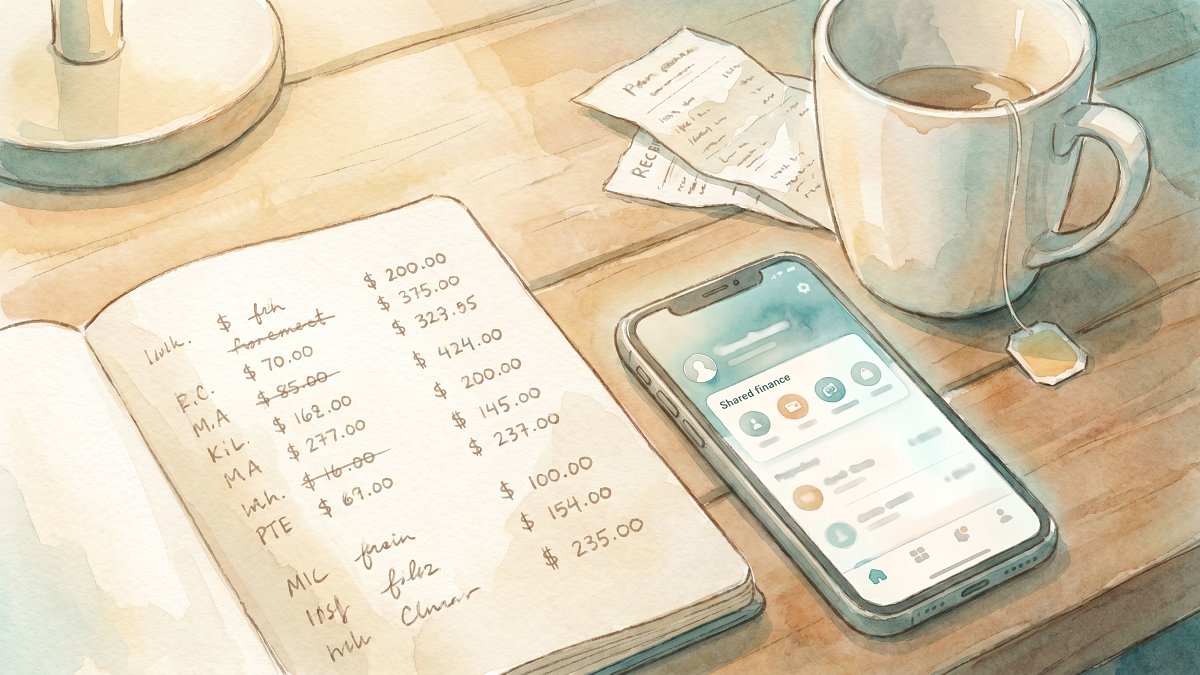
Logging in real time means every shared expense lands in the group trip running tab ledger the day it happens, ideally the hour it happens, not at the end of the trip. The reason is unglamorous: receipts pile up, memories drift, and the Sunday-night reconciliation becomes a 60 to 90 minute argument with three people checking their phones to see who paid for what at the Wednesday dinner.
Reddit's r/personalfinance threads on group expense splitting consistently arrive at the same answer: same-day entry, settled once at the end. The treasurer or whoever owns the chat posts a one-line confirmation when each entry lands. Splitwise free users hit a hard wall here: the free tier caps at 5 expenses per day (Splitty, March 2026), which is fine for a couple but tight for a 6-person trip that hits a breakfast, a lunch, a dinner, a cab, a museum, and a grocery run in one day. The workaround is to consolidate entries (one "day 2 shared meals: $410" instead of three individual restaurant entries) or to use a free alternative like Tricount or Splid that does not cap.
Numbers example. Day two of the same Lisbon trip. 9:48 AM, Liam pays $42 for pastries and coffee, logs $42 in the ledger. 1:15 PM, Maya pays $96 for lunch, logs $96. 4:33 PM, group Uber to a viewpoint, $28 on Priya's card, logged. 9:10 PM, $230 dinner on Sara's card, logged. By midnight the day-two ledger reads: Liam $42, Maya $96, Priya $28, Sara $230, total $396 in shared items, split six ways = $66 per person. No mystery, no Sunday court session.
Paste-ready script. "Real-time logging rule for this trip: every shared expense in the ledger within 30 minutes of the receipt, photo of the receipt in the chat, no exceptions. End-of-day, treasurer posts the running balance. Anyone who forgets just adds it the next morning and we re-balance."
Where it breaks. It breaks at the bar, where four drinks in nobody wants to type. The fix is voice notes: leave a 5-second voice memo in the chat ("$48 bar tab on my card, three drinkers split"), and the treasurer transcribes it in the morning. For the full real-time logging methodology, see Working out group trip running tab for logging in real time.
Skip tiny amounts: the per-trip threshold that saves an hour of logging
Skip tiny amounts is the rule that says any shared expense below a defined threshold rounds to zero in the ledger. It exists because logging a $3.50 bottle of water in a group of six produces a settlement of 58 cents per person, which is more cognitive effort than the saving is worth. NerdWallet's bill-splitting guidance treats this as common-sense roundoff; CNBC Select frames it as part of trip-planning communication.
The threshold is a number you agree on day one and write into the chat. Common values: $5 per item for a domestic US trip, $10 for an international trip with rough currency conversions, $15 for a high-end trip where most shared items are well over that mark. Below the threshold, the buyer just absorbs it. Above it, the item goes in the ledger as normal.
Numbers example. Six-person trip, threshold $5. Over four days, the group has 23 sub-$5 items: bottled water, parking-meter top-ups, a single bag of chips, two airport newsstand snacks. Total absorbed: $61.40. Split six ways on principle that would have been $10.23 each, but the logging would have taken about 8 minutes per item to add and settle, or roughly 3 hours of group time across the trip. The trade is real: $10.23 per person for 3 hours not on phones.
Paste-ready script. "Threshold for this group trip running tab is $5. Anything under $5 you bought for the group, just absorb it, no need to log. Anything $5 and over, log normally. If you want to flag a borderline one in the chat, that's fine, but please don't itemize the bottled water."
Where it breaks. Two failure modes. Threshold creep: someone starts skipping $7 items because "it is basically the threshold," and then $12. Hold the line. Asymmetric absorption: the person at the grocery store keeps buying the gum and chargers, and quietly carries $45 of skipped items. Track absorbed items loosely; at end of trip, the treasurer can reimburse one person if they obviously over-carried. The dedicated piece on this lives at What to do about skip tiny amounts.
Splitting cabs on the fly: the script that gets logged before the car stops
Cabs and rideshares are the group trip running tab category that most often falls out of the ledger, because the ride ends, the group walks into a venue, and nobody opens the app. The rule that works: the person who orders pays, every rider logs their share before the car door closes, and the entry is split among the riders only, not the full group. Uber's group splitting (CNBC Select coverage notes Uber supports this at order time) handles the math automatically when the orderer sets it up, but the manual version with a shared ledger works just as well if logged immediately.
The ride-share split is per-rider, not per-traveler. If three people of a six-person group take an Uber from the Airbnb to a venue, only those three split the fare. The other three are not on the ledger entry. This is why cabs are pay-as-you-go even when the rest of the trip is pooled: rideshares are too specific to spread.
Numbers example. A six-person trip splitting up for the afternoon. 1:50 PM, four people take an Uber XL to the beach, $52, logged $13 each on the four riders' lines. 4:30 PM, three of those four take a $26 Uber back early, logged $8.67 each on three lines. 6:15 PM, the fourth rider plus the two who stayed in the rental Uber together to dinner, $38, logged $12.67 each on three lines. Three separate entries, three different sub-groups, all logged before the next venue.
Paste-ready script. "Cab rule for this trip: orderer pays, riders log before we walk in. If you join late and rode for two stops, drop a Nudj entry for your portion of the leg, the orderer can confirm. Default split is even per rider unless we discuss."
Where it breaks. The fifth rider who jumped in for two of five stops. Half-leg accounting is painful. The clean answer is to call it before the car starts: "I'm only riding to the museum, $4 for me?" Then the orderer charges only $4 to that person on the ledger. The dedicated long-form for this is The splitting cabs on the fly fix, with a script.
Groceries pool versus individual: bulk staples on one line, everything else on yours
Groceries are the second-most-disputed category on a group trip running tab, after cabs. The rule: bulk staples that the group will share (coffee, eggs, pasta, oil, cleaning supplies, bottled water) go on a single group line. Anything you bought because you alone wanted it (your oat milk, your specific yogurt, your fancy cheese) goes on your own line. The dividing question is, "Will more than one person eat or use this?"
Most groups underbudget the first Costco or Trader Joe's run because they forget cleaning supplies, condiments, paper towels, and trash bags. Build the first run as a single $80 to $120 group line for staples, and then each traveler adds their own personal items in their own bag with their own card or a separate transaction.
Numbers example. Six-person trip, first grocery run at Trader Joe's. Group line $84.20 covers coffee beans, eggs, pasta, marinara, olive oil, salt, pepper, paper towels, trash bags, bottled water for the rental, and a six-pack of frozen vegetables. Split six ways = $14.03 per person. Same trip, Maya picks up her $11 oat milk on a separate transaction (she is the only oat-milk drinker), Liam gets his $9 of kombucha. Those two items never touch the ledger.
Paste-ready script. "Grocery rule: staples (coffee, eggs, oil, paper towels, water, salt, pepper, soap) on the group line, paid by whoever is at the register, logged as 'shared groceries.' Anything only you will eat or drink (your oat milk, your protein powder, your specific snacks) on your own transaction, off the ledger. If you are not sure, ask in the chat before paying."
Where it breaks. Two failure modes. The vegan in an all-meat household: shared meals start being half-individual when the vegan is making themselves a separate dinner, and the budget split distorts. Solve it by giving the vegan a partial credit on the grocery line. And the snack-hoarder: one person keeps buying "group" snacks that only they actually finish. The honest answer is to move those snacks off the group line as soon as it is clear. The full sub-topic is Groceries pool versus individual, sorted in five minutes.
Alcohol only among drinkers: the bar tab split that excludes the non-drinkers
The alcohol rule on a group trip running tab is the one fairness rule that most groups already follow informally but rarely state. Bar tabs are split only among the people who drank. Non-drinkers are exempt. Sober travelers, designated drivers, pregnant travelers, people in recovery, anyone who simply ordered a Coke, they pay zero of the alcohol line. The same logic applies to bottle service, wine at dinner, and the gin you bought at the duty-free for the rental.
The trickiest sub-case is mocktails. A non-alcoholic cocktail at a craft bar often costs $14 to $18, basically the same as a cocktail. Two options: count mocktails into the alcohol line (split with drinkers), or keep them on the food line (split with everyone). Most groups choose the food-line route, because the mocktail orderer is a non-drinker who would otherwise have ordered a soda.
Numbers example. Six-person trip, three drinkers and three non-drinkers. Tuesday dinner total $246, of which $76 was a shared bottle of wine and $36 was three beers. Food + non-alcoholic drinks: $134, split six ways = $22.33 each. Alcohol $112, split among the three drinkers = $37.33 each. Drinkers' actual line that night: $22.33 + $37.33 = $59.66. Non-drinkers' line: $22.33.
Paste-ready script. "Alcohol rule for the trip: any drink with alcohol gets split among drinkers only, ordered the same evening. Soda, juice, mocktails get split with everyone as part of food. If you are not sure how to mark a tab, ask before logging. No judgment on who drinks or who does not."
Where it breaks. Mixed drink orders at a single dinner where the bill arrives un-itemized. The clean fix is to ask the server for an itemized check before paying; most US and European restaurants will do this on request. If the venue refuses, the table estimates the alcohol portion (commonly 25% to 40% of a dinner bill, with cocktail-heavy nights pushing closer to 45%) and applies the group trip running tab rule to the estimate. The long-form piece is A fair rule for alcohol only among drinkers.
When the simple rule breaks down
Four situations push a group trip running tab past the simple rules. Each one needs a one-line decision in the chat before the trip starts.
- International trips with FX. Currencies, conversion fees, and same-day rate drift make Splitwise's free tier inadequate (currency conversion is a Pro-only feature, $40 per year, Splitty 2026). The cleanest workaround is to settle in one home currency at the end, using the same mid-market rate for every entry on the group trip running tab. Wise's mid-market rate (Wise pricing page, 2026) is the standard reference because it adds no FX markup, just a small variable fee starting around 0.33% on major currency routes; banks typically apply a 2.5% to 4% FX margin on debit-card use abroad, which the ledger should never inherit.
- Mixed-budget travelers. Bankrate's personal-finance guidance on managing money among friends with different incomes (2024) is blunt: the equal split feels unfair when the income spread is wide, and the cleanest fix is to let the higher earner cover one premium item (the wine pairing, the upgraded room) while the rest of the group splits the standard cost. Do not try to weight the entire ledger.
- Late arrivals and early departures. A traveler who joins on night two and leaves on the morning of night four should pay for two nights of the Airbnb, not four. NerdWallet's group-trip coverage recommends a per-night, per-room calculation up front so the math is clean.
- The group photographer or guide. When one traveler does meaningful work for the group (drives everyone, designs the itinerary, books all reservations), the group can offer to cover one of their meals or a partial credit on the ledger. State this on day one rather than letting it become a quiet imbalance.
When any of these four shows up, restate the rule out loud in the chat. The group trip running tab stays calm because of explicit decisions, not vibes.
How Nudj keeps a group trip running tab honest
Nudj is a 100 percent free social ledger for friends. Nudj does not process payments, is not a bank or money services business, and never stores card numbers; it only records who owes whom, so the actual money still moves over Venmo, PayPal, Zelle, Wise, or cash when the group settles. The product is built around the three social rituals friends already use on a group trip: drop a debt the moment it happens, nudge a repayment when the trip is over, and square up when both sides confirm.
Drop & Nudge for real-time entries. Drop a debt in three taps from the receipt photo: amount, who is in, what it is for. Nudge a polite repayment reminder when the trip ends. Drop & Nudge fits the real-time logging rule because the friction is low enough that nobody waits until Sunday night. For a 4-night, 6-person trip, expect to drop 25 to 40 entries across the trip, fully under the Nudj free tier with no daily cap.
Circles & Tables for the trip group. A Circle is a group expense pool. A Table is the recurring version (your monthly poker night, your roommate ledger, your yearly ski trip with the same crew). Create a Circle for this trip on day one, add the six travelers, set the split philosophy (pool vs pay-as-you-go) per category, and every Drop lands on the Circle. The Pass feature simplifies tangled chains of debts within the Circle the way Splitwise's debt simplification does, but on a permanently free tier with no ads.
Square Up for the final settlement. When the trip ends and the ledger balances, each pair confirms the settlement on both sides. Square Up is the two-sided confirmation that prevents the "I already paid you" disagreement two weeks later.
Nudj is permanently free, has no premium tier, no ads, and never moves money. The closest comparable in the consumer market is Splitwise, which since 2011 has been the category leader but now paywalls receipt scanning, currency conversion, and the 5-per-day expense cap behind a $40 annual subscription (Splitty, March 2026). Tricount, owned by the European bank bunq, is free for core features but pushes its own card. Nudj is bank-agnostic, fully free, and built around the social ritual rather than the feature list. Drop the first entry on day one; you will have a clean ledger by the time the plane lands.
FAQ: Group trip running tab questions, answered
How often should we settle a group trip running tab during the trip itself?
Do not settle mid-trip unless someone is leaving the group early. Log every shared expense in real time, but hold all settlements until the trip is over. Mid-trip settlements create double-counting risk and slow down everyone's flow. The exception: if someone departs early, settle their balance the morning they leave so they are not chasing payments after they fly out. Splitwise, Nudj, and Tricount all keep the running balance live so you always know where you stand even without settling.
What is the right per-person kitty contribution for a 4-night group trip?
$150 to $250 per person is the working range, with $200 the median for a 6-person, 4-night trip in a US or European city. The number should cover lodging cleaning fees, ground transport, the first grocery run, group activity reservations, and a buffer of about $40 per person for unplanned shared items. Top up by $100 per person when the kitty hits $100 remaining. Anything left over at the end is refunded equally.
Which app is best for a group trip running tab if we hate paid subscriptions?
The permanently free options as of 2026 are Nudj, Tricount, Splid, and Settle Up. Splitwise's free tier still works but caps at 5 expense entries per day (Splitty, March 2026), which is tight for a 6-person trip with multiple receipts per day. Nudj has no cap, no ads, no premium tier, and no daily expense limit. Tricount, owned by bunq, is strong on multi-currency. Splid works fully offline, which matters for international destinations with patchy data.
How do we handle a group trip running tab when one person makes much more money than the others?
Do not try to weight the ledger by income, the math gets messy and the social cost is high. The cleaner pattern, per Bankrate's guidance on friends with different incomes (2024), is to let the higher earner cover one premium item the group would not have chosen on its own (the wine pairing, the upgraded room, the chef's tasting menu) and split everything else evenly. State this on day one so it does not feel like charity in the moment.
What is the right threshold for skipping tiny amounts on a group trip running tab?
$5 per item is the standard threshold for a domestic US trip, $10 for an international trip with currency conversion noise, and $15 for a high-end trip where most shared items are well over that anyway. Set the threshold in the chat on day one and do not change it mid-trip. If one person ends up over-absorbing (they bought all the chargers and gum), the treasurer reimburses a flat amount at the end.
Can we just use Venmo or Zelle to settle the running tab without an app?
Yes for very small groups (2 or 3 people, fewer than 8 entries total) or for a kitty-style trip where one treasurer handles everything. For a 4-to-8-person trip with 20 to 40 entries, you will want a shared ledger to track who paid for what; Venmo, Zelle, Cash App, and PayPal are the settlement layer at the end, not the running ledger during the trip. Verified Venmo accounts can send up to $60,000 weekly (PrimeWay, 2026), which is well above any normal trip total, and Zelle limits vary by bank.
What do we do if someone refuses to log their expenses in real time?
Designate them as the receipt-photo person instead of the ledger person. Every time they pay, they photograph the receipt and post it in the group chat. The treasurer or whoever runs the ledger transcribes it that evening. You lose 30 minutes of nightly admin but keep the running tab honest. If they refuse even the photo, the group sets a rule: anything not logged within 24 hours rounds to zero, and that person eats the cost.
Conclusion
A calm group trip running tab is the product of eight explicit decisions, taken on day one, restated when an edge case shows up, and logged in real time so nothing piles up. The simple rules (one card rotates, designate a treasurer, pool the universals, log same-day, skip tiny amounts under threshold, split cabs per-rider, group-line the staples, alcohol-only-among-drinkers) cover roughly 95% of the friction on a typical group trip running tab. The remaining 5% (international FX, mixed budgets, partial nights, group operators) needs a one-line chat decision when it appears. None of this requires a paid app, and none of it requires a spreadsheet; running the group trip running tab cleanly comes down to saying the rule out loud before the receipts start arriving.
À lire également :
- How to Group trip running tab When One card rotates
- Group trip running tab, the designate a treasurer version
- Pay as you go versus pool and group trip running tab, how to keep it fair
- Working out group trip running tab for logging in real time
- What to do about skip tiny amounts
- The splitting cabs on the fly fix, with a script
- Groceries pool versus individual, sorted in five minutes
- A fair rule for alcohol only among drinkers
Sources :
- Splitwise Pro features and pricing : Splitwise, 2026.
- Splitwise free limits in 2026 : Splitty, March 2026.
- How to split travel costs with friends and family : Erica Silverstein, The Points Guy, January 2, 2023.
- Travel tips: how to split expenses on a group vacation : CNBC Select, August 2024.
- Venmo vs Zelle vs PayPal vs Cash App 2026 comparison : PrimeWay Federal Credit Union, February 2026.
- Wise transfer fees and pricing : Wise, 2026.
- Smart ways to split bills with friends abroad : NerdWallet, May 2024.
- Best bill-splitting apps roundup : NYT Wirecutter, March 2024.
- Splitting expenses thread : Reddit r/personalfinance, 2023.
- Staying friends when salaries differ : Bankrate, April 2024.
- Splitting payments and cleaning fees on Airbnb : Airbnb Help Center, June 2025.
- The app Splitwise is the best hack to split group trip expenses in 2026 : Namerah Saud Fatmi, Android Central, April 28, 2026.