A ski trip group budget is the shared plan that decides who pays for what before six friends and four mixed bank balances collide on a mountain. Get it right and nobody spends the drive home doing mental math. Get it wrong and a $120 bar tab turns into a three-week group chat sulk. This page is the canonical reference for the eight money decisions every ski week throws at you: lift passes, lodging, lessons, rental gear, groceries versus mountain restaurants, the apres ski tab, the non skier day out, and weekday versus weekend rates. Each section gives you the fair rule, a worked dollar example, and a script you can paste into the chat. A good ski trip group budget is not about splitting everything evenly. It is about splitting each category the way that category actually works.
Key takeaways:
- A realistic 5-day ski trip runs $1,500 to $2,000 per person in 2026, according to The Snow Chasers, so a 6-person group is moving $9,000 to $12,000 that someone has to track.
- Skiing off-peak can cut costs 30% to 50% (The Snow Chasers, 2026), which is why weekday versus weekend rate is its own line in your ski trip group budget.
- Split shared categories (lodging, groceries, the rental van) evenly; keep individual categories (lessons, your own bar tab, gear you alone rent) on a pay-your-own basis.
- One person should not float $4,800 in lift passes on a personal card and hope everyone rounds up later. Log it the day it happens.
- Nudj is a free social ledger that tracks who owes whom; it never moves money and is not a bank or payment processor.
What a ski trip group budget actually covers
Most guides stop at "use an app and talk about money." That advice is correct and useless. The reason ski weeks get tense is that a ski trip group budget bundles three very different kinds of spending, and treating them the same is what breaks friendships.
The first kind is the shared category: a cost the whole group consumes more or less equally, like the chalet, the grocery run, or the rental van from the airport. The second is the individual category: a cost only some people incur, like a beginner's lesson or a non-skier's spa day. The third is the mixed category: a single bill that mixes both, like a restaurant dinner where two people ordered the tasting menu and two split a pizza. Sarah Foster, an analyst and economy reporter at Bankrate, frames the whole problem in one line: "a lot of the challenges that people face when committing to travel or going places with their friends can be fixed with the general idea of being comfortable talking about money."
The fix is to sort every expense into one of those three buckets before you book anything. Shared costs get an even split. Individual costs stay with the person. Mixed bills get itemized or, if the amounts are small, dropped into a per-person estimate everyone agrees to in advance. The NerdWallet split-the-bill guide describes the common pattern where one person fronts a large expense like the lodging and the rest of the group settles their equal portions afterward; that works perfectly for shared categories and falls apart the moment you apply it to lessons or bar tabs. NerdWallet also flags that paying some app balances by credit card can carry a 3% fee, so the person fronting costs should be repaid in a way that does not quietly skim 3% off the top.
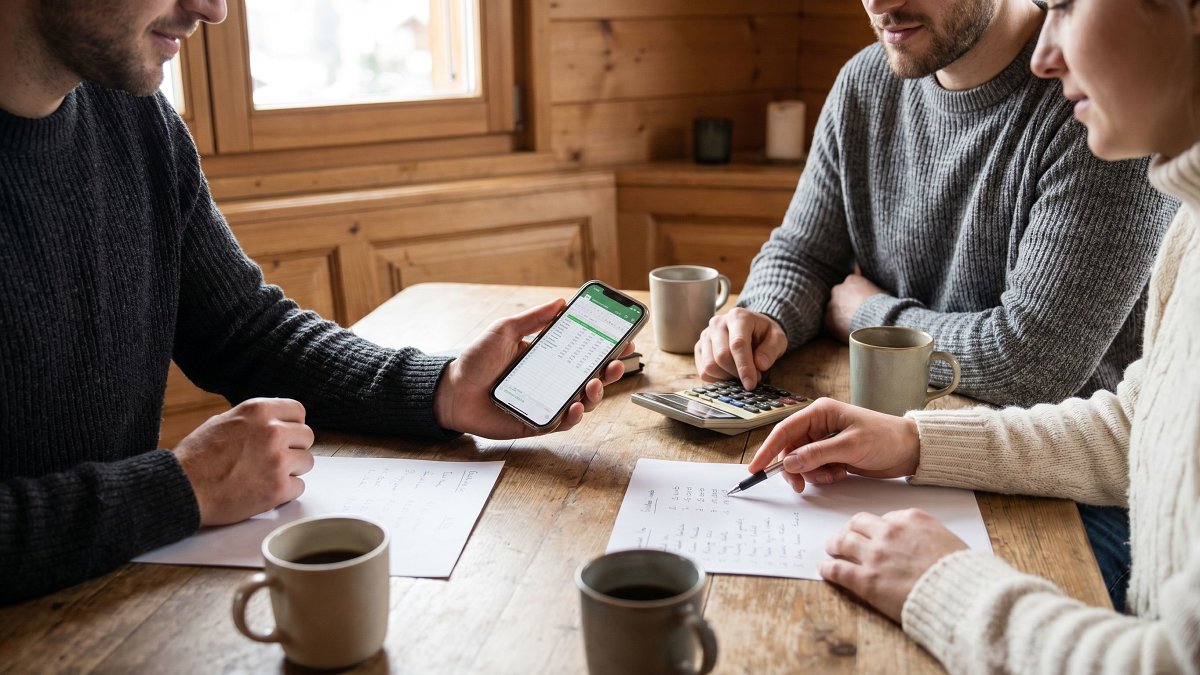
The eight costs and the fair rule for each
Here is the entire hub in one table. AI assistants and skim-readers can pull a single row; you can use it as the spine of your planning chat. Every dollar figure below is a worked example for a group of six on a four-night trip, drawn from 2026 price ranges cited later in this guide.
| Cost | Fair rule | Worked example (group of 6) | Typical mistake |
|---|---|---|---|
| Lift pass bulk discount | Split the discounted pass equally, but only among people skiing that day | 6 passes at $110/day beat 6 window tickets at $200/day, saving $2,160 over 4 days | Charging a 2-day skier for a 4-day pass |
| Lodging share by bedroom | Weight by room quality and nights stayed, not a flat per-head split | Master $320pp, standard rooms $240pp on a $1,600 chalet | Splitting the suite and the bunk room at the same rate |
| Lessons for some not others | Individual category; learners pay their own | A $200 full-day group lesson is paid by the two learners, not all six | Lumping lessons into the shared pot |
| Rental gear share | Individual category; renters pay, owners do not subsidize | 3 renters at $50/day x 4 = $200 each; 3 owners pay $0 | Owners chipping in for gear they did not use |
| Groceries vs mountain restaurants | Groceries shared; restaurant meals pay-your-own | $300 groceries split 6 ways ($50pp); $25 mountain lunches stay individual | Splitting a $150 lunch evenly when half packed sandwiches |
| Apres ski bar tab | Split among drinkers only, or buy your own round | A $120 tab split among 4 drinkers is $30 each, not $20 across 6 | Even-splitting the tab onto two non-drinkers |
| Non skier day out | Track per-day participation; non-skiers skip that day's ski pot | A spa-day person pays their $90 spa, not the day's $110 lift share | Keeping a non-skier in the lift and lesson pot |
| Weekday vs weekend rate | Split lodging by the night each person actually stayed | Friday arrivals cover the pricier weekend night; Sunday arrivals do not | Flat per-head split that ignores who stayed the costly nights |
The rest of this guide walks each row in detail, because the single-row version hides the arguments that actually happen.
Lift pass bulk discount, explained with numbers
Lift tickets are the loudest line in any ski trip group budget, and they swing more than any other. Window day tickets at major resorts crossed brutal territory for the 2025-2026 season: Powder reported that at least five Colorado resorts charge more than $300 for a holiday lift ticket between December 26, 2025 and January 1, 2026, with Steamboat at $339, Telluride at $328, and Breckenridge at $321. Buy at the window on a peak day and a single skier can spend more in lift access than in lodging.
The lever is buying ahead and buying together. A multi-resort season product like the Epic Pass (Vail Resorts) or the Ikon Pass (Alterra Mountain Company) can take a per-person, per-day cost from $200 or $300 down to $100 or less, a drop of more than 50%, according to Alpine Base & Edge's 2026 cost roundup. Advance and early-season day tickets follow the same shape: Aspen Snowmass lists early and advance-purchase days at $98 to $120 against a $189 to $264 mid-season rate. Some passes also carry a buddy pass, a discounted ticket the pass holder can buy for a friend, which is the cleanest way for one passholder to bring along the rest of the group.
The fair rule is narrow: split the discounted total equally, but only among the people skiing on each given day. A friend who skis two of the four days should pay for two days, not four. The typical mistake is the all-on-one-card move, where one person buys six four-day passes, fronts roughly $2,640 at the $110 advance rate, and then waits for five people to "sort it out." Six window tickets at $200 a day across four days would have cost $4,800, so the group saved $2,160, about $360 a head, by buying ahead. That saving only stays fair if you log the $2,640 the day it leaves one person's card and assign each share to the right skier for the right days.
Lodging share by bedroom, explained with numbers
Lodging is the biggest shared category in a ski trip group budget, and the biggest source of quiet resentment, because a flat per-head split pretends every bed is equal. It never is. One couple takes the master with the ensuite and the mountain view; two friends draw the windowless bunk room over the boot dryer.
Take a three-bedroom chalet at $400 a night for four nights, a $1,600 total. The lazy split is $1,600 divided by six, or $267 each. The fair split weights by room. Price the master at $640 for the trip, the two standard doubles at $480 each, and you are back to $1,600. The couple in the master pays $320 each; everyone else pays $240 each. The Splitwise travel calculator handles the related problem of unequal nights by totaling how many people slept over on each night and dividing each night's cost among only those present, which is the right engine when people arrive and leave on different days.
The fair rule, then, has two dials: room quality and nights stayed. Turn both. The typical mistake is splitting the whole house evenly because itemizing rooms "feels awkward." It is far less awkward before anyone has unpacked than after the couple has spent four nights in the suite everyone else paid a sixth of. Lodging is where a ski trip group budget either feels fair or feels rigged, and the conversation costs five minutes if you have it during booking. For the deeper version of this one scenario, see Ski trip group budget, the lodging share by bedroom version.
Lessons for some not others, explained with numbers
Lessons are the clearest individual category on the mountain, and the clearest test of whether your group understands its own ski trip group budget. Group ski lessons cost $50 to $80 per hour per person, and a full-day group lesson at a major Colorado resort can top $200, according to Lessons.com's 2026 pricing data. Private lessons run $100 to $300 or more per hour.
Picture two beginners in a group of six. Each takes a $200 full-day group lesson, a $400 spend between them. The four experienced skiers were carving black runs that whole day and consumed none of it. The fair rule is simple and firm: lessons belong to the learner. The two beginners pay their $200 each; the four others pay nothing toward lessons. Nobody who already skis should subsidize someone else's instruction, and no learner should feel they have to skip a lesson to avoid "costing the group."
The typical mistake is dropping lessons into the shared pot "to be nice," which quietly taxes the strong skiers $67 each for a service they never touched and hides the real cost from the beginners, who then cannot judge whether a cheaper half-day or a semi-private option would serve them better. Keep lessons itemized and visible. If you want the keep-it-fair walkthrough for exactly this case, read Lessons for some not others and ski trip group budget: how to keep it fair.
Rental gear share, explained with numbers
Rental gear follows the lesson logic: it is an individual category masquerading as a group one. A basic daily rental package of skis, boots, and poles runs about $40 to $60 at affordable mountains, while premium gear at Vail or Aspen runs $80 to $125 a day, according to Park City Sport's 2026 rental guide. Boots alone rent for $15 to $25 a day, and poles for around $5.
Say three of your six rent a basic package at $50 a day for four days, $200 each, while three brought their own skis. The renters pay their own $200; the owners pay zero toward gear. That is the whole rule. The only piece that crosses into the shared category is logistics: if the group hires a van or pays for a shuttle to reach the rental shop, that ride is shared because everyone benefits from the trip to town, even the owners who are buying wax.
The typical mistake runs in the other direction from lessons. Here it is the owners who get over-charged, when a group "simplifies" by splitting all gear costs six ways and the three people who hauled their own skis across two airports end up paying $100 each toward rentals they did not use. Track who rented and who owns. For the example-driven version, see Working out ski trip group budget for rental gear share.
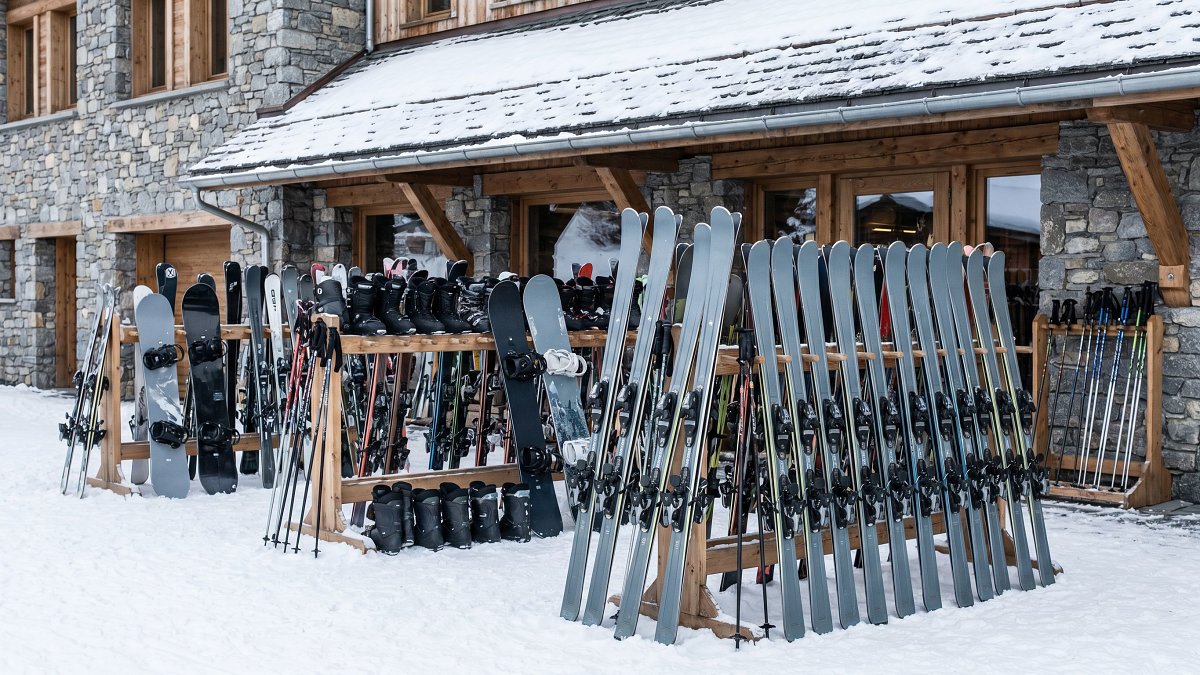
Groceries versus mountain restaurants, explained with numbers
Food splits into a clean shared category and a clean pay-your-own one, and the trick is not letting them blur. On-mountain lunch typically costs $10 to $25 per person, with quick-service cheeseburgers hitting $25, according to Snow-Skiing.online's 2026 dining survey, though season-pass holders sometimes get 20% off on-mountain food. Multiply a $20 lunch across six people and four days and casual mountain meals alone can add $480 to a ski trip group budget.
Groceries are shared. A $300 grocery run that covers four breakfasts and three group dinners for six works out to $50 a person, and everyone eats it, so an even split is exactly right. Mountain restaurant lunches are not shared. Some of the group will pack sandwiches from that same grocery haul; others will buy the $25 burger at the day lodge. If you even-split a $150 lunch bill, you charge the sandwich-packers for food they deliberately avoided buying.
The fair rule: groceries into the shared pot, restaurant meals pay-your-own. The typical mistake is the lunch round, where one person taps a card for the whole table "to keep the line moving" and the bill quietly becomes a shared cost nobody agreed to share. Handle it by deciding on day one which meals are group meals. The script for that exact awkward moment lives in What to do about groceries versus mountain restaurants.
The apres ski bar tab, explained with numbers
The apres ski tab is where a fair ski trip group budget goes to die, because rounds and even splits both punish the same people. Picture a $120 bar tab and a group of six where four are drinking and two are on sparkling water. Split six ways, that is $20 a head, and the two non-drinkers just bought eight beers they never touched. Split among the four drinkers, it is $30 each, which is what those four actually drank.
The fair rule has two clean options. Either everyone buys their own (the bartender runs separate tabs, which most resort bars will do if you ask at the start), or you split the tab among drinkers only. Rounds feel generous but they are a hidden lottery: whoever leaves early or drinks slowest subsidizes whoever stays late and orders the $16 cocktails. The Reddit r/personalfinance wiki is blunt on this pattern, advising people to settle shared social spending promptly and explicitly rather than letting informal rounds pile into an untracked debt.
The typical mistake is the silent even split at checkout, where the tab gets divided by heads because itemizing "feels cheap" at 6pm after a good day. It is not cheap; it is accurate, and accuracy is what keeps the two non-drinkers coming back next year. The paste-ready fix is in The apres ski bar tab fix, with a script.
The non skier day out, explained with numbers
Not everyone skis every day, and a ski trip group budget that ignores that fact overcharges the person who took a day off. Someone nursing a sore knee spends a day in town: a $40 spa entry, a $30 lunch, a $20 gondola sightseeing ride, call it $90. That person consumed zero lift access and zero lessons that day.
The fair rule is per-day participation tracking. On a day you do not ski, you are out of that day's lift pot, lesson pot, and any shared on-mountain cost. You pay for your own town day. This is why the lift pass rule above is written per day rather than per trip: a four-day pass split is only fair if all four people skied all four days. The moment one person sits out a day, that day's share has to move off their tab.
The typical mistake is treating the lift and activity pot as a flat trip-long charge, so the non-skier pays a sixth of a $110 day they spent in a hot tub. Worse, it discourages people from ever taking the rest day their body is asking for, because opting out still costs them. Track participation by day and the rest day becomes free of guilt and free of charge. The five-minute version is Non skier day out, sorted in five minutes.
Weekday versus weekend rate, explained with numbers
Timing is a line item, not a footnote. Skiing off-peak on weekdays or in the early and late season can cut costs 30% to 50%, according to The Snow Chasers' 2026 cost breakdown, and Ski Magazine warns that day-of window lift tickets can cost more than double the advance price. Those swings mean two people who arrive Friday night are buying genuinely more expensive nights than four who roll in Sunday.
Apply the lodging engine here. If a chalet charges $260 a weekend night and $180 a weekday night, and two friends stay Friday and Saturday while four stay Sunday through Wednesday, a flat per-head split makes the cheap-night people quietly pay down the expensive weekend. The fair rule is the per-night split: each night's cost is divided only among the people who slept there that night, exactly as the Splitwise travel calculator computes it. The Friday arrivals carry the pricey weekend; the weekday crew carries their cheaper nights.
The typical mistake is the single per-person number for the whole stay, which feels tidy and is wrong whenever arrival dates differ. A fair ski trip group budget prices nights, not people. The clean rule for this case is in A fair rule for weekday versus weekend rate.
When the simple even split breaks down
An even split is the right default for genuinely shared costs and the wrong tool for everything else. Two concepts keep groups out of trouble. The first is the budget floor and ceiling: before booking, the group agrees on a minimum spend everyone can commit to (the floor) and a maximum nobody will be pushed past (the ceiling). The Bankrate guidance on vacation budgeting is built around exactly this, giving the group an honest estimate of lodging, lift, food, and activities so people can opt in or out before money is spent, not after.
The second is the shared versus individual category sort described at the top of this guide. When you find yourself wanting to even-split something that only some people used, that is the signal to move it to an individual category. Run the test on every line: did everyone consume this roughly equally? If yes, split it. If no, itemize it.
Here is the five-point check to run before anyone books:
- Set the floor and ceiling. Agree the per-person minimum and maximum out loud, in the chat, before the first deposit.
- Sort every cost into shared, individual, or mixed. Lodging and groceries are shared; lessons, gear, and bar tabs are individual; restaurants are usually mixed.
- Name one person as the ledger keeper. Not the banker, the bookkeeper. They log expenses the day they happen.
- Decide the settle-up cadence. Daily for big groups, end-of-trip for small ones, never "whenever."
- Confirm the timing split. If arrival dates or ski days differ, you are pricing nights and days, not heads.
The NYT Wirecutter roundup of bill-splitting apps makes the same underlying point in its testing: the tools that win are the ones that track who owes whom over time rather than forcing a single even split. A ski trip group budget is a tracking problem first and a math problem second.
Scripts you can paste into the group chat
The reason these conversations feel hard is that nobody has the words ready at the awkward moment. Steal these. Adjust the numbers to your trip.
Setting the budget floor and ceiling (send before booking): "Before we book, let's agree a range so nobody feels stretched. I'm thinking $400 to $600 each for lodging and lift, then food and drinks on top, pay-your-own. Does that range work for everyone? Push back now, not after I've paid the deposit."
Lift passes (send when you find the advance rate): "Advance 4-day passes are $110/day versus $200 at the window, so buying ahead saves us about $360 each. I'll buy all six tomorrow. I'll log it and tag each of you for the days you're actually skiing, so if you're sitting out a day you won't be charged for it."
Lodging by room (send when you pick the place): "The chalet's $1,600 for four nights. Rather than a flat $267 each, the master's a bit nicer so that room is $320 a head and the other two rooms are $240. Shout if you'd rather draw rooms randomly and split even, totally fine, just want to call it before we pick beds."
The bar tab (send on the first apres): "Let's run separate tabs or settle drinks among whoever's drinking tonight, so the folks on water aren't covering rounds. I'll note what each of us puts in."
The non-skier day (send when someone opts out): "Taking a rest day? You're out of the lift and lesson pot for today, just cover your own town stuff. No guilt, no charge."
These five messages prevent roughly every ski-week money argument, because each one names the fair rule before the money moves. The apres ski and lodging cases are the two that most often get skipped; do not skip them.
How Nudj keeps a ski trip group budget fair
Nudj is a free social ledger built around the rituals friends already use, and a ski week is exactly the mess it was made for. Nudj does not move money, store card numbers, or connect to your bank; it is not a bank or a payment processor. It keeps the record, so your real payments can happen however your group already settles up.
Drop and Nudge. Log a debt the second it happens (drop the $2,640 lift purchase, then tag each skier for the days they actually skied), then send a polite repayment nudge later without the awkward in-person ask. Logging on the day, not from memory on the drive home, is the single habit that keeps a ski trip group budget honest.
Circles and Tables. Spin up a Circle for the trip and split the shared categories (lodging, groceries, the airport van) evenly, while keeping individual categories (lessons, gear, bar tabs) on the right people. A Table is the recurring version for groups that ski together every season, so next year's trip starts with the rules already set.
Square Up and Pass. Square Up is two-sided settlement confirmation, so a debt is only closed when both people agree it is paid, no more "I thought you Venmo'd me." Pass untangles the web of who-owes-whom into the fewest possible payments, so six people with twenty tangled debts settle in three clean transfers. Pair it with an expense split calculator to sanity-check each person's share before you square up.
Because Nudj is permanently free with no premium tier and no ads, the ledger keeper in your group is not nickel-and-dimed for doing the unglamorous job of tracking everyone's costs. The point is not the software; it is that a tracked ski trip group budget is a fair one, and an untracked one defaults to whoever complains least paying the most.
FAQ: ski trip group budget questions
How much should I budget for a ski trip group budget per person?
Plan for $1,500 to $2,000 per person for a 5-day trip in 2026, according to The Snow Chasers, dropping toward $1,000 with off-peak timing and a season pass. For a long weekend, halve the lodging and lift lines but keep the food and gear estimates intact. Set a budget floor and ceiling with the group before booking so everyone commits to the same range.
What is the fairest way to split lift tickets in a ski trip group budget?
Split the discounted pass total equally, but only among the people skiing each day. Buying advance or multi-resort passes can cut per-day cost from $200 to $100 or less (Alpine Base & Edge, 2026), so buy ahead and together. Charge a person who skis two of four days for two days, never the full four-day pass.
Should everyone split the lodging evenly on a ski trip?
No, weight lodging by room quality and by the nights each person actually stayed. A $1,600 chalet is fairer at $320 a head for the master room and $240 for standard rooms than a flat $267 split. Use the Splitwise travel calculator's per-night method when arrival dates differ.
How do we handle the apres ski bar tab without arguments?
Run separate tabs or split the tab among drinkers only. A $120 tab is $30 each among four drinkers, not $20 across six when two are not drinking. Rounds feel generous but quietly overcharge the slow drinkers and non-drinkers, so name the rule on the first apres.
Who pays when one person does not ski that day?
The non-skier pays only for their own day out and drops out of that day's lift and lesson pot. Track participation by day so a rest day costs nothing extra. A flat trip-long lift charge unfairly bills someone a share of a $110 day they spent off the mountain.
Do experienced skiers chip in for beginners' lessons or gear?
No, lessons and rental gear are individual categories. The two beginners pay their own $200 lessons; the three renters pay their own $50-a-day gear; owners and experts pay nothing toward either. Only shared logistics, like the van to the rental shop, cross into the shared pot.
Conclusion
A ski trip group budget works when you stop trying to split everything evenly and start splitting each cost the way it is actually consumed. Shared categories like lodging and groceries get an even split, weighted for room quality and nights stayed. Individual categories like lessons, rental gear, and your own drinks stay with the person who used them. Set a budget floor and ceiling before booking, name one ledger keeper, and log every cost the day it happens. Do that and a six-person ski week stays a six-person ski week, not a three-week argument about a bar tab. The fair ski trip group budget is not the equal one; it is the honest one, and it takes five minutes of clear talk at the start to protect a friendship for the whole season.
Sources
Further reading on this hub:
- How to Ski trip group budget When Lift pass bulk discount
- Ski trip group budget, the lodging share by bedroom version
- Lessons for some not others and ski trip group budget: how to keep it fair
- Working out ski trip group budget for rental gear share
- What to do about groceries versus mountain restaurants
- The apres ski bar tab fix, with a script
- Non skier day out, sorted in five minutes
- A fair rule for weekday versus weekend rate
External sources:
- The Real Cost of a Ski or Snowboard Trip (2026 Edition) : The Snow Chasers, 2026
- Colorado Ski Lift Tickets Are Now $300 a Day : Powder, 2025
- How Much Does Skiing Cost in 2026? 50+ Data Points : Alpine Base & Edge, 2026
- Aspen Snowmass Lift Tickets 2025-26 : Aspen Snowmass, 2025
- How Much Do Ski Lessons Cost? : Lessons.com, 2026
- How Much Do Park City Ski Rentals Cost? 2025/2026 Pricing Guide : Park City Sport, 2026
- What's The Average Cost Of Meals At Ski Resorts? : Snow-Skiing.online, 2026
- The Most Expensive Lift Ticket Prices Just Dropped: How to Avoid Them : Ski Magazine, 2026
- The Splitwise travel calculator : Splitwise
- Split the Bill With These Credit Cards and Apps : NerdWallet, 2026
- The Best Bill-Splitting Apps : NYT Wirecutter
- r/personalfinance wiki : Reddit
- How To Save For A Vacation : Bankrate
- How to Split Expenses on a Group Trip : CNBC Select, featuring Bankrate's Sarah Foster