
You see the same people every Tuesday for poker, every other Sunday for supper club, every Thursday at the gym, and every December for the office Secret Santa. The money that moves between you is small per night, sometimes only fifteen dollars, sometimes a fantasy league entry of fifty. The cumulative social cost of getting it wrong is enormous. A 2024 Bread Financial national study found that 21% of adults have lost a friendship over money, and that figure climbs higher when the same group repeats the same exchange week after week. This pillar shows you how to track group expenses recurring across nine different rituals, without arguments, without losing receipts, and without quietly becoming the one who always covers the tab.
Key takeaways
- 76% of Americans now use at least one peer-to-peer (P2P) payment app like Venmo, PayPal, Zelle, or Cash App, according to a Pew Research Center survey conducted July 5 to 17, 2022.
- 21% of adults have lost a friendship over money, and 57% have borrowed from friends; 30% of those borrowers never repaid (Bread Financial study, May 2024).
- Recurring rituals fail on three layers, not one: the math (who paid what), the manners (who feels what), and the cadence (how often the same imbalance repeats).
- The rule that prevents 80% of friction when you track group expenses recurring: write the number down within twenty four hours, in one shared place, with the date and the people involved.
- The nine hubs in this family cover poker nights, fantasy sports, rec leagues, book clubs, supper rotations, weekly brunches, birthdays, Secret Santa, and office pools, with the same underlying method to track group expenses recurring across all of them.
What recurring social rituals actually mean in everyday friend money
A recurring social ritual is a small, repeated activity that the same group of people does on a regular cadence and that involves money changing hands or being owed. The cadence is what makes it different from a one-off group trip. A bachelor party happens once and gets settled in a single Venmo storm the next morning. A weekly poker night happens fifty times a year, and the small imbalances accumulate into resentment if no one is keeping score. To track group expenses recurring is therefore not the same task as splitting one bill; it is the task of keeping a running ledger alive across many small events with the same people.
The word ritual is deliberate. These activities are not transactions. They are something between a habit and a tradition, embedded in friendships, marked on calendars, and protected by the people who run them. The money is incidental to the point of the gathering, but it cannot be ignored, because the same group will be back at the same table next week, and the math from last week is still on the books.
The rituals in this family share four traits. The same people show up most of the time. The cadence is fixed (weekly, monthly, seasonal, annual). The dollar amounts per session are small enough that no one wants to involve a bank or a contract. The social stakes are larger than the financial stakes by a factor of roughly ten to one.
The 2022 PayPal Canada Holiday Snapshot Survey, which polled 2,000 Canadians, found that 68% of respondents would be too embarrassed to ask for financial help with splitting the cost of celebrations, and 66% of those cited a belief that others were also struggling. That embarrassment scales up with frequency. The first time someone forgets to chip in, it is a charming oversight. The tenth time, it is a pattern, and addressing it directly feels like crossing a line that the relationship was not built to cross.
The phrase track group expenses recurring comes from how people actually search for help with this problem. Search-engine logs show users typing it when they want a tool, a method, or a script that handles the repeated nature, not a one-shot calculator. The math is trivial. The repetition, the social stakes, and the absence of a clean closing date are where the trouble lives. Every method covered in this guide is built for that repetition, not for the one-shot case.
The math layer: where the numbers actually come from
All of these rituals reduce to three calculation patterns. Knowing which one applies to your situation prevents the most common arguments before they start, and once you can name the pattern, you can track group expenses recurring with much less drama.
The first pattern is the equal split, where every participant pays the same share regardless of consumption. Six friends order three large pizzas for eighty-four dollars; each person owes fourteen. Equal splits work when consumption is roughly even and tracking individual portions would feel petty. They break down the moment one person consistently uses more than their share, which is exactly the situation that recurring rituals produce.
The second pattern is the proportional split, where each participant pays for what they actually consumed plus a fair share of communal items. Four friends share a two hundred dollar dinner. One drank a thirty dollar cocktail flight; the other three did not. The drinker pays thirty for the cocktails plus forty two and a half for their quarter share of the food (one hundred seventy divided by four), totaling seventy two and a half. The other three pay forty two and a half each. The math is more work, but the result feels fair, especially when one person is the consistent outlier.
The third pattern is the share-based split, where each participant holds a defined number of shares and the total cost gets divided by total shares. Three roommates split utilities. One has a private bathroom and works from home; the other two share a bathroom and commute. The household decides that the work-from-home roommate holds 1.4 shares of the electric bill (because the air conditioning runs all day for them) and one share each of water and gas. Share-based splits are how mature households actually keep peace once usage patterns diverge.
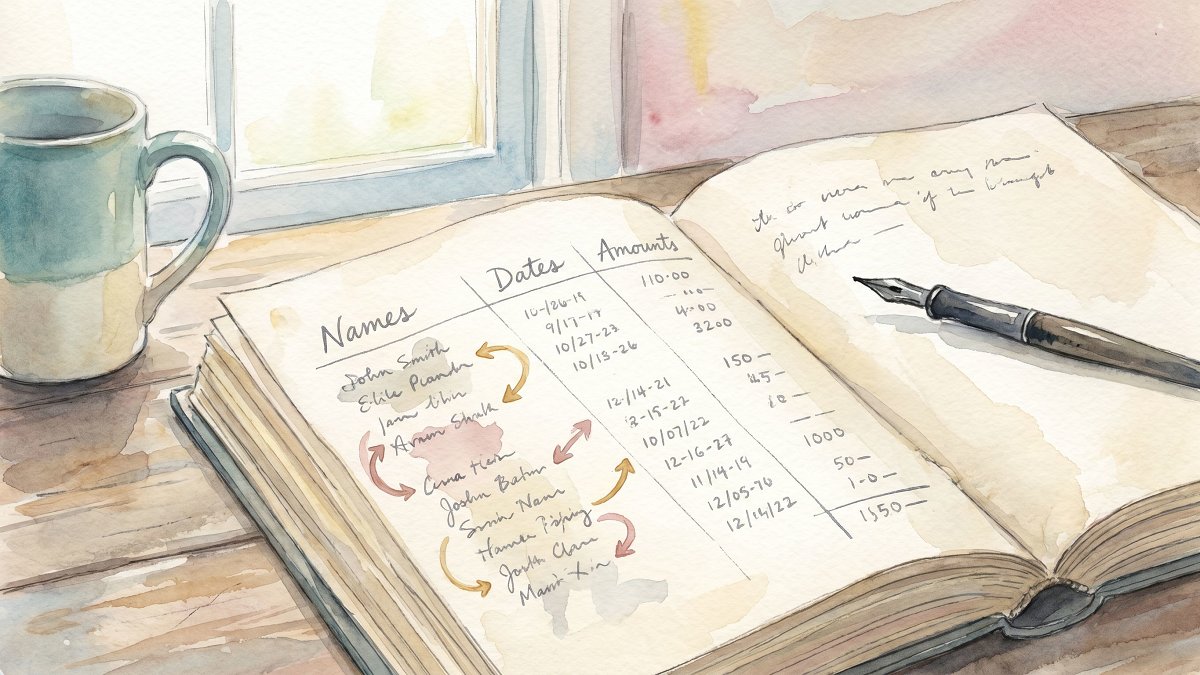
The recurring twist on all three patterns is that the math does not close at the end of the night. A weekly poker game runs from January through December. The fantasy football league season is twenty weeks. The book club is open ended. The pattern of who covered which week, who owes which week, and who is currently up or down lives in a running ledger, not a single receipt. This is what people mean when they say they need to track group expenses recurring rather than just split one bill, and it is the part most generic split-the-bill tutorials skip.
The debt simplification algorithm that Splitwise popularized in 2012 is the single most useful piece of math for any recurring group. It operates on three rules. Everyone ends the cycle owing the same net amount they actually owe. No one ends up owing a person they did not already owe. No one ends up owing more in total than they did before the simplification. Applied to a recurring group, if Anna owes Bob twenty for last week's pizza and Bob owes Charlie twenty for last week's wine, the simplifier tells Anna to pay Charlie twenty directly and clears both edges in one transaction. Across a five person poker game with fifty sessions a year, this kind of routing can reduce two hundred plus pending settlements to under twenty actual payments.
Before your first session, decide which pattern applies, who is responsible for logging, and how often you close the books. The five questions worth answering, in this order:
- Who is in the group, exactly. Names, not roles. "My friend's roommate" is not a name.
- What is the cadence. Weekly, biweekly, monthly. Pick one and commit.
- What is the split pattern. Equal, proportional, or share-based, plus a written reason.
- Who logs and how. One person, one tool, every session. Multiple loggers create reconciliation work later.
- When do you close and settle. End of each session, end of month, end of season. Floating ledgers rot.
Getting these five answers in writing before the first dollar moves is the single most effective intervention any recurring group can make.
The manners layer: when small money gets socially loaded
The math is the easy part. The reason people pay for an app to handle it is the manners layer underneath, and that layer is where every attempt to track group expenses recurring either survives the year or quietly destroys the group.
The Society for Personality and Social Psychology (SPSP) summarized the research clearly in 2023. Friendships operate as communal relationships, characterized by a deliberate refusal to keep itemized records of who owes whom. Romantic partners, close friends, and family members feel insulted when their relationship is treated like an accounting entry. Casual acquaintances, by contrast, operate as exchange relationships, where score keeping is expected and even reassuring. The trouble with recurring rituals is that they straddle both modes. The group is close enough to feel communal, but the activity itself (a poker game, a fantasy league) is structurally an exchange.
Researchers Angulo, Goldstein, and Norton, writing for SPSP in 2023, reported that shame emerges as the strongest predictor of strained relationships after a borrowing event. Not anger, not resentment, not the dollar amount. Shame, on the part of the borrower, about being seen as the person who owes. This is why polite friend groups end up in silent standoffs over twenty seven dollar pizza debts. The borrower is too ashamed to bring it up; the lender is too polite to ask.
This is also where digital records change the dynamic. Cash had a forgiving vagueness. A twenty pressed into someone's hand on the way out the door was forgotten by Monday. A Venmo charge with a description like "pizza Tues" is a permanent record visible to everyone in your network, including people who were not at the dinner. The math problem got easier. The social problem got harder, because the record now follows the relationship.
Etiquette expert Myka Meier, quoted by CNBC on November 13, 2022, said the single most useful intervention is timing. Voice any concern before you put your order in. Once the bill arrives, you have lost the negotiation. Once the bill is split unevenly week after week, you have lost the friendship's communal frame and replaced it with quiet bookkeeping resentment.
Three practical manners rules apply to every ritual in this family. Surface intent early: if you cannot afford this week's stake, say so before chips are dealt, not after. Normalize the ledger: keep the running record where everyone can see it, so no one feels singled out when they appear. Close the books on a fixed cadence: monthly is comfortable for most recurring groups, season-end works for fantasy leagues, annual works for Secret Santa rotations. A ritual without a closing cadence becomes a ritual that quietly damages the group.
A short tour of the nine hubs in this family
Each of the hubs below is its own world with its own scripts, edge cases, and gotchas. This tour gives you the contour; the dedicated hub pages go deep on each. Across all nine, the same habit lets you track group expenses recurring without rebuilding a system from scratch every season.
1. Poker night money. The classic recurring ritual. The math is simple per hand (chips in, chips out) but compounds across the season, especially if the host runs a small rake (a percentage of the pot kept by the house) for snacks or covers a missing player. A clean buy in cash out log records each player's chips in and chips out per session, settles the same night, and resets to zero the next week. The most common failures are the floating banker problem (one person holds everyone's cash physically) and the ratholing problem (a player pockets winnings mid-game). For weekly games with a stable roster, learning to track group expenses recurring across sessions is the difference between a tradition and a slow argument. Read Poker night money, how it works without arguments for the full hub.
2. Fantasy sports leagues. Entry fees, side pots, weekly survivor bets, and end-of-season payouts. A typical twelve team fantasy football league at fifty dollars per entry holds six hundred dollars in the prize pool for twenty weeks. The risk is the commissioner who collects in August, holds the money in a personal Venmo balance, and forgets which two managers never paid. LeagueSafe, launched specifically to solve this, holds the prize pool in escrow until the season ends, with no commissioner access during the season. The basic plan is free, with optional paid features for premium leagues. Fantasy is the easiest place in this family to use a dedicated escrow service, because the entry fees are predictable, season-long, and high enough to justify the workflow.
3. Sports clubs and rec leagues. Adult kickball, beer league hockey, climbing co-ops, running clubs that pool money for shirts. The cadence is seasonal but predictable. The recurring expense is league dues split across roster slots; the variable expense is one-off costs like a tournament entry or a team dinner. A roster app paired with a single shared ledger handles this cleanly. Where it breaks: late joiners, mid-season replacements, and the person who shows up to two games and ghosts on the dues for the rest of the season. The fix is to publish the ledger to the whole roster on the day dues are collected, so no one can later claim they did not know.
4. Book clubs and discussion groups. Small dollars per session (snacks, drinks, the occasional shared book). The recurring pattern is host rotation: one member hosts each month and provides the main spread, while others bring drinks or sides. Money rarely changes hands directly; instead, the hosting tax is the cost of hosting, distributed across the year by virtue of rotation. The mistake is letting the rotation drift, so that two members end up hosting four times a year while two others never host. A visible rotation calendar fixes this, and a shared ledger that logs each host's grocery spend turns implicit favors into a transparent, fair pattern over the year.
5. Dinner clubs and supper rotations. Higher dollars per session than book clubs. A casual rotating supper club where four couples take turns hosting every other Sunday means each couple cooks roughly once every other month, with a per-evening cost between fifty and one hundred and twenty dollars depending on the menu. Some supper clubs use a flat per-head contribution (often thirty five to forty dollars) to defray the host's outlay, especially when the host is also providing wine. The recurring math is mostly about smoothing peaks, since the host bears the full cost in their month and recovers it via the rotation. To track group expenses recurring across a year of supper rotations, the simplest pattern is a single shared sheet with the host's spend logged each month and a year-end balance check.
6. Weekly brunch and standing hangs. The smallest dollars per occurrence (a coffee, a brunch, occasionally a check) but the highest frequency. Fifty two Saturdays a year times an average tab of twenty two dollars equals one thousand one hundred and forty four dollars in recurring spend per person, of which a meaningful fraction is touched by other people's payments. This is the ritual where Venmo records most visibly do not match what people remember, because the line items are too small to mark. The trick is a monthly close: total what everyone fronted, net it out, and reset.
7. Birthday celebrations year-round. Group gifts, group dinners, occasional pooled cash for a bigger present. A friend group of eight, each with a birthday, runs eight birthday rituals a year. If a typical group dinner gift contribution is thirty dollars per person, each member contributes two hundred and ten dollars across the year, minus the thirty they would notionally receive in their own birthday's contribution. The recurring math is symmetric in theory, lopsided in practice, since some birthdays attract more contributors than others and the totals never quite balance. Group gift apps and dedicated ledgers help, but the real win is to track group expenses recurring across the calendar year rather than per event.
8. Secret Santa and holiday exchanges. Annual, single-cadence rituals with a published budget. The Society of Etiquette informally and most workplace guides explicitly recommend a budget range between twenty and thirty dollars, with a hard cap stated up front. The recurring social ritual is not the gift itself but the draw mechanic (who draws whom, when, and how), which most groups run via a free online tool. The mistake is letting one member opt out silently, which leaves their drawer holding a gift for no one. Set the cap before the draw; communicate it in the announcement; include taxes and shipping in the per-person budget calculation.
9. Office pools and bracket contests. March Madness brackets, Oscars pools, fantasy survivor pools, World Cup pools. Annual or seasonal cadence, ten to twenty dollar entries, twenty to fifty participants. The legal landscape varies by jurisdiction (most U.S. states permit small de minimis office pools, though employer policies often forbid them on company property). The mechanics are simple; the recurring problem is the manager who collects forty entries and then no one can remember who paid in May when the August payout happens. A short paid-list in a shared place, refreshed every entry, prevents 90% of these disputes.
This family of nine is more than the sum of its hubs. The same group that runs your poker night probably also runs your fantasy league, hosts your supper club, and chips in for your birthday. The same ledger habit serves all of them.

Common mistakes when you track group expenses recurring
Five failure patterns appear in almost every group that has been running a ritual for more than a year. Each has a fix that costs nothing except agreement, and each is a reminder that to track group expenses recurring is mostly a habit problem, not a tool problem.
Tool-hopping. Starting on a chat thread, moving to a spreadsheet, switching to one app, then trying another, all within the first season. Every migration loses data. The fix is to pick one ledger and stay there for the entire season, even if it is not the perfect tool. A consistent imperfect ledger beats four perfect ledgers with gaps between them.
Logging gross only. Recording the price of the pizza but not the tax, tip, delivery fee, or the host's grocery run to top up snacks. Over a year of weekly poker nights, the host snacks tax alone can amount to four to five hundred dollars borne by one person if it never gets logged. The fix is to put every dollar into the same ledger, including small ones; that is what it means to actually track group expenses recurring rather than just remember the big ones.
Letting math drift. The group makes a casual decision in March ("let's say Anna covers next week and we'll figure it out") and never figures it out. By September, no one remembers what they agreed to, and Anna either swallows the loss or starts the awkward conversation. The fix is a strict close cadence: every month, every season, every quarter.
Single-fronter cash flow. One member, usually the most patient or the most financially comfortable, repeatedly covers shared costs without ever sending a nudge. The lender's record grows in the background while the borrowers forget. After six months, the lender either has a hard conversation or starts skipping events. The fix is the Drop and Nudge pattern: log the debt immediately, send a polite reminder within seventy two hours.
Mixing personal and group payments. Using Venmo to pay both your share of dinner and your personal half of an Airbnb booking, in the same week, with the same friend, produces a ledger that nobody can read three months later. The fix is to keep group ledgers separate from personal payments, ideally in a dedicated app that does not move money, so the act of tracking is unbundled from the act of paying.
How four named apps handle the core mechanic
Most recurring groups will eventually try at least one of four named apps. Each takes a different angle on the same problem of helping a group track group expenses recurring across many sessions.
| App | Free tier | Recurring expenses | Debt simplification | Settlement confirmation | Best fit |
|---|---|---|---|---|---|
| Splitwise | Limited (with ads, paywall on advanced splits) | Yes (monthly, weekly, yearly, fortnightly) | Yes (network-flow algorithm) | One-sided (sender marks paid) | Long-running groups that need recurring templates |
| Tricount by bunq | Full (no ads) | No native recurring | No simplification beyond pairs | One-sided | Trips and one-off groups |
| Settle Up | Generous free, paid for premium | Yes | Yes | One-sided | Android-first groups, simple shared expenses |
| Nudj | Free with no premium tier, no ads | Yes (Tables for recurring contexts) | Yes (via the Pass feature) | Two-sided (Square Up confirms both ends) | Recurring friend rituals including poker, supper clubs, leagues |
The row-level differences matter. Splitwise pioneered the debt simplification feature in 2012 and remains the reference implementation, but its free tier increasingly paywalls features like itemized splits and receipt scanning. Tricount, owned by the European bank bunq since 2022, is excellent for one-shot trips but lacks native recurring expense support and integrates a card-pushing flow into the app. Settle Up has the cleanest balance visualization and a strong Android experience, though its name and onboarding lean toward one-off use rather than ongoing rituals. Nudj is built specifically for the recurring case and adds two mechanics absent elsewhere: a Tables group type designed for poker games and similar contexts where the same group meets repeatedly around a literal table, and Square Up two-sided confirmation, where both the payer and the receiver acknowledge the settlement so the ledger closes cleanly.
The two-sided confirmation matters more than it looks. One-sided settlement (most apps) lets the payer mark a debt as paid, but the receiver has no equivalent gesture; the ledger updates on trust. In a group that has been together for six months, that trust is usually fine. In a group that has been together for six years, the small ambiguities accumulate, and a two-sided Square Up is the cheapest way to keep the books exactly aligned with reality.
Nudj does not move money. There are no bank links, no card numbers stored, no payment processing. The app is a social ledger, which means the user records what happened and uses any payment rail they prefer (Venmo, Zelle, PayPal, cash) to settle. This is the principal architectural difference from Splitwise and Settle Up, both of which now offer optional money movement, and it is the reason Nudj can remain free with no premium tier. To track group expenses recurring across a year, the ledger is the recurring artefact; the payment app is the disposable one.
Three rules of thumb worth memorizing
Write it down within twenty four hours. Memory decay accelerates past one day. A debt logged the same night gets remembered; a debt logged on Friday for Tuesday's expense gets disputed. Twenty four hours is the practical upper bound. Use whatever tool you have, but do it before you go to bed twice. This is the single rule that does the most work to track group expenses recurring without arguments.
One ledger, one source of truth, one season. Pick a tool for the season (the fantasy football year, the supper club's program, the poker league's calendar) and stay there. Migrations during a season lose data and reset trust. If you outgrow the tool, finish the season, then switch at a natural boundary.
Nudge early, not late. The window between debt and resentment is shorter than people think, especially for recurring groups. The first nudge should land within seventy two hours and should be matter of fact, not apologetic. The polite drop and nudge pattern (log the entry, send a one line reminder) lowers the social cost of asking and protects the friendship from the slow-burn version of the same conversation three months later. Even the most casual group benefits from a written nudge cadence once they decide to track group expenses recurring as a shared discipline.
How Nudj helps you run these rituals
Nudj is a 100% free social ledger built specifically for the friend groups that show up week after week. The product is a web app today, with native iOS and Android apps in development. There is no premium tier; there are no ads. Nudj does not connect to your bank, does not store card numbers, and does not process payments. It is the record that lives next to your friendships, not a financial institution. Designed end to end to track group expenses recurring across many small events, the app starts from the assumption that the same people will be back next week.
Three features map directly to the recurring rituals in this family.
Drop & Nudge. Drop is the act of logging a debt in seconds (who owes whom, how much, for what). Nudge is the polite repayment reminder that lands in the receiver's inbox without the awkward in-person conversation. For weekly rituals, dropping each session's entries within twenty four hours and nudging on a monthly close keeps the manners layer intact while the math layer takes care of itself.
Circles & Tables. A Circle is a persistent friend group (your housemates, your supper club, your fantasy league). A Table is a dedicated structure for groups that meet around a literal table, with built-in support for poker sessions, including buy ins, cash outs, rake, and color up at the end of the night. Tables exist because most expense apps treat poker like a generic dinner split, which loses the structure of the game. The dedicated Buy in cash out log without the awkward pause fiche walks through the end-of-session close.
Square Up & Pass. Square Up is a two-sided settlement confirmation: when you pay someone back, both of you mark the entry as settled, so the ledger closes cleanly without one-sided disputes. Pass is the routing engine that simplifies tangled chains of small debts inside a group, mirroring the debt simplification approach Splitwise made famous, so a five person group with twenty pending entries can settle in three actual payments instead of twenty. The color up end of night fix, with a script walks through how the end-of-session close works for a poker game; the What to do about the banker role fiche covers how to assign and rotate the cash-handling responsibility without it becoming a permanent burden.
Nudj is for the rituals you already run with the people you already trust. The app is not a replacement for cash, Venmo, Zelle, or your bank. It is the record that sits between them, so the friendship is not the thing that has to remember the math, and so you can track group expenses recurring without inviting a financial institution into the conversation.
FAQ: how to track group expenses recurring with friends
How do I track group expenses recurring without an app?
A shared spreadsheet works for groups under six people with a clear logger and a strict monthly close. Use one row per session, one column per participant, and a running total at the bottom. The failure mode is administrative: someone has to maintain the sheet, and the same person usually ends up doing it forever. For groups over six, or for rituals that repeat for more than a season, a dedicated tool to track group expenses recurring reduces the workload and removes the single-point-of-failure problem.
What is the difference between a recurring expense app and a payment app?
A payment app (Venmo, Zelle, Cash App, PayPal) moves money between bank accounts. A recurring expense app or social ledger (Splitwise, Tricount, Settle Up, Nudj) records who owes whom. Many recurring rituals need both: the ledger to track group expenses recurring across sessions, and the payment app to settle balances. Nudj deliberately does not move money, so you can use whichever payment rail your group prefers.
Is it rude to ask a friend to pay me back for a recurring expense?
Not when it is the explicit shared agreement, and not when the ask is timely. According to etiquette expert Myka Meier, quoted by CNBC on November 13, 2022, the key to good etiquette is good communication, and sooner is better. A polite reminder within seventy two hours of the original expense is the social baseline. The longer you wait, the more uncomfortable the conversation becomes for both sides.
Why does Splitwise simplify debts and should I use it?
Splitwise's debt simplification feature, introduced in 2012, restructures debt within a group to minimize the total number of payments needed to settle. It obeys three rules: everyone ends owing the same net amount, no one ends up owing a person they did not already owe, and no one ends up owing more in total than before. For long-running groups with many small transactions, simplification turns dozens of pending settlements into a handful of actual payments. It is genuinely useful and the same logic is implemented under various names by every modern social ledger that promises to track group expenses recurring, including the Pass feature in Nudj.
How much should we budget for office Secret Santa?
Most workplace guides converge on a range between twenty and thirty dollars per gift, with a hard cap stated up front so participants know what to aim for. Set the cap before the draw; communicate it in the announcement; include taxes and shipping in the budget calculation; and make participation optional. Aiming close to the cap is preferred over significantly underspending, which can make a recipient feel undervalued.
What is the safest way to collect fantasy football league dues?
LeagueSafe is the dedicated service for fantasy sports entry fees. Once the season starts, the funds are on lockdown until the season ends, which means no commissioner, including a well-intentioned one, can accidentally or deliberately access the prize pool mid-season. The basic plan is free. The alternative is a commissioner who collects via Venmo or PayPal and holds the money personally, which is workable in small leagues with high trust but is also the source of most commissioner-related disputes.
How often should we close the books on a recurring ritual?
Monthly is the comfortable default for most weekly or biweekly rituals. Season-end works for fantasy leagues, rec leagues, and bracket pools. Annual works for Secret Santa, birthday rotations, and supper clubs that are loosely tracked. The principle is to pick a cadence and stick with it: a group that closes every month for two years is healthier than a group that closes "whenever" and lets balances drift. A predictable close cadence is one of the most underrated tools to track group expenses recurring across a multi-year ritual.
Conclusion
The groups you see every week are worth more than the money that moves between you, and that is exactly why the small math matters. A poker game that ends with a tidy ledger is a poker game you can run for ten years. A supper club where everyone trusts the host rotation is a supper club where the cooking gets better every season. Once you have a shared method to track group expenses recurring, the rituals stop being a quiet source of friction and start being what they were always supposed to be: the standing reason to see your friends. The hubs linked below go deep on each ritual; start with the one you are running this week.
À lire également :
- Poker night money, how it works without arguments
- How to Poker night track buyins When Buy in cash out log
- Poker night track buyins, the rake policy version
- Host snacks tax and poker night track buyins: how to keep it fair
- Working out poker night track buyins for rebuy rules
- What to do about the banker role
- The color up end of night fix, with a script
- Online versus cash night, sorted in five minutes
- A fair rule for prize pool or pure cash
- Buy in cash out log without the awkward pause
Sources
- Payment apps like Venmo and Cash App bring convenience and security concerns to some users : Pew Research Center, 2022
- From friends to foes: money ruins 1 in 5 friendships : Bread Financial, 2024
- Debts Made Simple : Splitwise Blog, 2012
- Splitting the bill? This situation is the last thing you want, etiquette experts say : CNBC, 2022
- PayPal survey reveals over half of Canadians are too embarrassed to ask for financial help this holiday season : PayPal Canada, 2022
- Friendship Fallout and Bailout Backlash: The Psychology of Borrowing and Lending : Society for Personality and Social Psychology, 2023
- Tips for managing family lending and borrowing : Consumer Financial Protection Bureau, 2023
- LeagueSafe : LeagueSafe official site, 2026
- Venmo Revenue and Usage Statistics : Business of Apps, 2025
- Split the Bill, Avoid the Headaches With These Credit Cards and Apps : NerdWallet, 2024
- The 6 Best Apps for Splitting Bills With Friends : HerMoney, 2024