You and seven friends just ate dinner. The check is $432.18 with tip already in. Someone pulls out their phone, opens the calculator, types 432.18 ÷ 8, gets $54.0225, and announces, "It's fifty-four bucks each." Done. That is the entire job when you split bill equally. The trouble is everything around it: who paid the deposit, who ordered the $19 cocktail, who arrived an hour late, whether the eleven-year-old at the end of the table counts as a full share. This page walks through every version of the question with a concrete dollar amount, a named app behavior, and a script you can paste into the group chat, so the next time you split bill equally is a five-second math job, not a fifteen-minute negotiation.
Key takeaways:
- The math is one line: total ÷ number of people, rounded up to the cent for non-payers. Splitwise, Tricount, Cash App and Venmo all use this exact formula when you split bill equally.
- 36% of Americans have lost a friendship over money and 41% have had a money disagreement with a friend, per the LendingTree 2025 Friends and Money Report (August 25, 2025).
- 32% of lenders did not get their money back the last time they covered a friend (LendingTree, 2025). U.S. adults say they are owed an average of $926 by friends or family (PayPal / YouGov survey, June 2024).
- Equal works when everyone consumed roughly the same. Switch to by item for the restaurant where one person got the wagyu, by share for rent or utilities, by income when paychecks differ widely.
- This page covers eight sub-topics in one place: four way, six way, eight way, round numbers, edge cases, fast mental math, when equal feels unfair, and kid half share. Each one has a dollar example and a paste-ready script.
What it actually means to split bill equally, and when to use it
When you split bill equally, you take a number, divide it by a count, and hand back the same amount to everyone. The whole thing fits on a napkin. The reason it still ends in arguments is that "the same amount" runs into people who ordered differently, paid different deposits, or showed up at different times. So before any math, you and the group decide one thing: is this a context where equal makes sense, or not?
An equal split makes sense when (a) the things being paid for are shared by everyone, like a pitcher of beer, an Airbnb living room, or a Sunday roast you all ate; (b) the difference in individual consumption is small enough that arguing about it would cost more than the difference; or (c) the group has a standing agreement that this is how it always works, like a Thursday poker table that splits the buy-in and the late-night pizza.
An equal split stops making sense the moment one person ordered $80 of wagyu and another ordered $14 of salad, or when a roommate uses the whole upstairs and another sleeps in the converted closet. For those cases, the right rule is by item or by share. Equal is the wrong tool for the job, no matter how convenient it looks.
The single phrase that unlocks every other section on this page: before you reach for the calculator, agree on the split rule out loud. Splitwise's product team has been making this point since 2011, when the company launched specifically because, as its founders put it on the company blog, "in the US and many other countries, most restaurants are unwilling to create a separate check for each guest" (Splitwise Blog, 2013). The check arrives whole. Someone has to call the rule.
A paste-ready script for the moment the check lands: "Quick one before I add it up, are we splitting this evenly, or by what each person had?" Most groups will pick evenly. The ones that will not pick evenly will tell you in three seconds, and you save the argument.
The math behind every time you split bill equally, in one sentence
The whole formula is this: divide the total by the number of people, then round each share up to the nearest cent so the payer is not left short. That is it.
Splitwise, Tricount, Cash App's Pools, Venmo's "Split" button, PayPal's "Request from group", and Wise's group payments all do exactly this calculation when you split bill equally with the equal-split option selected. The only thing that changes between apps is what they do with the leftover cents, which we get to in the round numbers section below.
A worked example: split bill equally for a $147.60 bar tab among four people. 147.60 ÷ 4 = 36.90 exactly. Four people send $36.90 each, totalling $147.60. Done.
A second example, with cents that do not cooperate: a $148.00 dinner among three. 148.00 ÷ 3 = 49.3333. The honest answer is $49.33, $49.33, $49.34, where the third person eats the extra cent. Or everyone sends $49.34 and the payer keeps two cents of float. Either is correct. The wrong answer is $49.33 across the board, because then the payer is one cent short.
That formula covers 95% of cases. The remaining 5% are: someone arrived late, the deposit was paid earlier, the tip was added unevenly, one of you is a kid, or someone did not drink. Each of those is its own section below, with its own dollar example.
The fast mental math you actually use at the table is even shorter: divide by ten, then adjust. A $96 bill for six people: 96 ÷ 6 is "around $16". The exact figure is $16.00. A $138 bill for five: 138 ÷ 5 is "between 27 and 28". The exact figure is $27.60. The full walkthrough is in the fast mental math fix, with a script, which we link here because most people freeze at exactly the wrong moment.
Splitting four ways, six ways, and eight ways: the worked examples
Three group sizes account for most times friends split bill equally in practice: the dinner for four, the apartment for six, the weekend trip for eight. Each has a different mental-math shortcut and a different failure mode.
The four-way split (dinner, double date, four roommates)
The setup: $176.40 at a restaurant, tip already in, four people, everyone ate and drank roughly the same.
The math: 176.40 ÷ 4 = $44.10 each. No leftover cents, no negotiation.
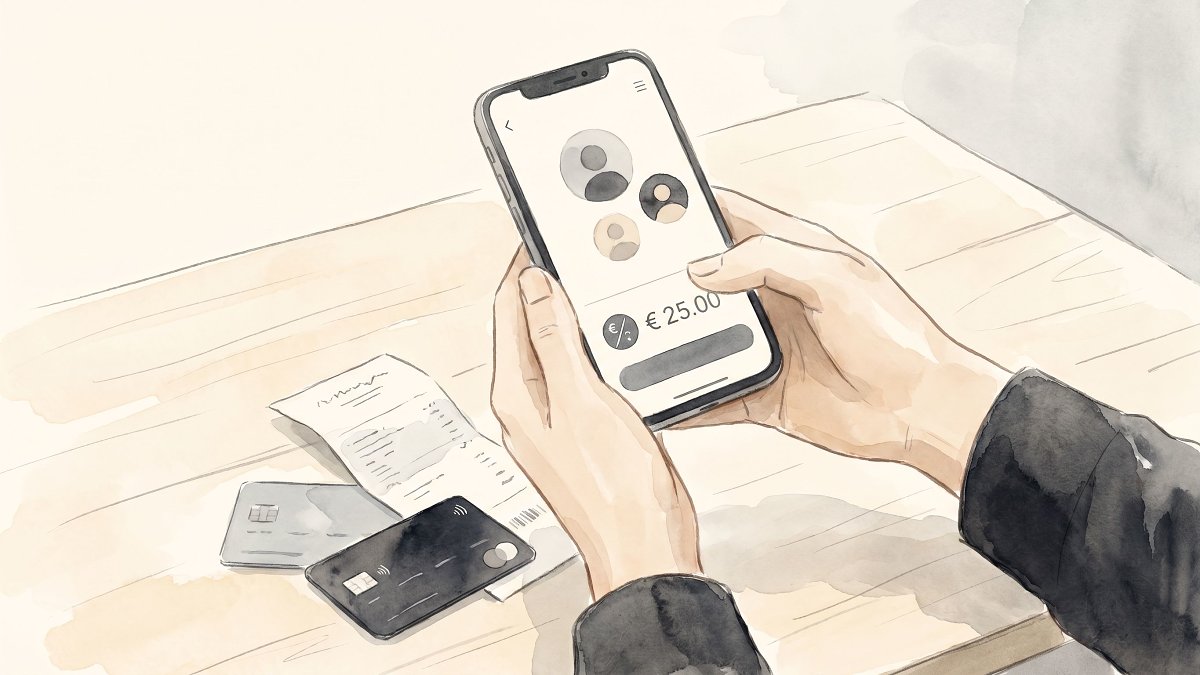
The Venmo behavior: one person pays the server, opens Venmo, taps the payment in their feed, hits "Split", picks the other three friends, and Venmo divides the amount automatically. Each friend gets a request for $44.10. The Venmo Credit Card adds a second route here: per NerdWallet's 2024 bill-splitting guide, the Venmo Credit Card carries a unique QR code that links to your Venmo account, so friends or family can scan it at the table to cover their portion of a purchase.
The script: "Just dropping a Venmo for $44.10 each, tip is in. Send when you get a sec."
The failure mode: someone says, "Wait, I only had the salad." Either you switch to by item (a different page) or you remind the table you agreed on equal at the start. For a full step by step with three more scenarios, see How to Split bill equally When Four way.
The six-way split (group brunch, three couples, six-person Airbnb)
The setup: $258 brunch with tip, six people. Most of you had pancakes, one of you had eggs benedict, the differences are small enough not to bother itemising.
The math: 258 ÷ 6 = $43.00 each. Clean.
A trickier number, split bill equally with six people: $279.45 ÷ 6 = $46.575, which rounds up to $46.58 per person. Five non-payers send $46.58 each (total $232.90). The payer paid $279.45 up front, so their effective share is $279.45 minus $232.90 = $46.55, three cents below the rounded amount. The Splitwise app handles this rounding automatically and labels the leftover cents in-app; the human-friendly version is "the payer eats the difference, and it is rarely more than a few cents per head".
The Cash App behavior: open the Cash App, tap "Request", enter the amount, select the five friends, hit send. Cash App will not auto-split the way Venmo does, so you do the math once and send the same request to five people.
The script: "Cash App $46.58 each. Bonus points if you send before we leave the table."
For the full version, including the awkward late arrival, see Split bill equally, the six way version.
The eight-way split (poker table, group dinner, eight-person ski trip)
The setup: $432.18 dinner with tip, eight people. The eight-seat table tends to be a recurring social group where one person always pays then chases.
The math: 432.18 ÷ 8 = $54.0225, which rounds up to $54.03 per person. Seven non-payers send $54.03 each (total $378.21); the payer paid $432.18, so their effective share is $432.18 minus $378.21 = $53.97, six cents below the rounded amount.
The Zelle behavior: Zelle does not have a built-in group split, but it is instant and free if everyone's bank supports it. You send eight separate $54.03 requests. NerdWallet recommends Zelle when both parties have a supporting bank because it clears instantly and carries no fee, which makes it the preferred rail for plain split bill equally settlements between adults who already bank somewhere mainstream.
The script: "Zelling everyone for $54.03. Sorry for the spam, settling tonight."
The failure mode at eight: someone always forgets to send. Two weeks later you are still $54 short. This is the exact problem a shared ledger like Nudj was built for, and it is also why the eight-person table is the hardest size to handle on plain payment apps. The full version is in Eight way and split bill equally: how to keep it fair.
Round numbers and the leftover penny problem
The cleanest time you split bill equally is when the math lands on an integer cent for everyone, like $176.40 ÷ 4 = $44.10. The frustrating one is the kind that ends in 1/3 or 1/7 and leaves a leftover penny or two that no app can divide.
A worked example: $50 for three people. 50 ÷ 3 = $16.6666. The honest split is $16.67, $16.67, $16.66. The payer takes the $16.66 share so they are not short. Total: $50.00 exactly.
A bigger one: $1,000 for seven people on a weekend Airbnb. 1000 ÷ 7 = $142.857142. Six people send $142.86, the seventh sends $142.84, total $1,000.00. Splitwise and Tricount handle this rounding automatically and the in-app history shows the exact distribution, so a year later you can still see who got the rounded-down share. Doing the same on PayPal "Request from group" or Cash App means you do the math yourself once and trust your own arithmetic.
A working rule: always round up to the nearest cent for the non-payer. The payer eats the rounding loss because they are already out of pocket and they are the one collecting; this preserves the goodwill of the act. It costs the payer at most (n − 1) cents, where n is the number of people. For a 100-person split with a one-cent leftover per person, that is 99 cents. Nobody is going bankrupt.
The script when the math is ugly: "Quick rounding note: I'm asking everyone for $142.86, I'll cover the extra two cents myself."
Round numbers show up the other way too: when the group decides to ignore the cents entirely and round to the nearest $5 or $10 to make Venmo less annoying. $147.60 for four becomes $37 each ($148 collected), the payer pockets 40 cents. This is fine for a casual one-off and a friend-tax for the payer (they did the work, the rounding pays them back). It is not fine for ongoing groups where the same person always pays, because the friend-tax compounds over a year. The cleanest move: round to the cent and send the exact number. For the full breakdown, see Working out split bill equally for round numbers.
Edge cases: late arrivals, leavers, dietary skips and the deposit someone paid in March
These are the five scenarios that turn a clean attempt to split bill equally into a 20-minute side conversation.
Late arrival. Five of you sit down at 7pm, the sixth arrives at 8:30pm after most of the appetizers are gone. The total is $312. Equal would be $52 each, but that punishes the late arrival who only ate $18 of food. Two clean options: (a) the late arrival pays for what they ordered, the other five split the rest equally, so $312 minus $18 is $294 ÷ 5 = $58.80 each; or (b) the late arrival sends a fixed "I joined late" amount like $35, the rest split the remainder. Per food editor Kiki Aranita (former co-chef of Poi Dog, now at New York Magazine), the rule is to ask for the separate check at the start of the meal, not the end, and on shared appetizers, "you have to get their consent at the beginning of the meal" (NPR, July 2024).
Early leaver. Four of you ordered dinner together, but one had to leave before dessert and coffee. Same rule, reversed: the leaver pays their share of the main meal, the remaining three split anything ordered after they left. Script: "I had the pasta and the wine, that's about $44 with tip. Venmo on its way, you guys finish without me."
Dietary skip. Six people at the table, two of you do not drink. The wine bill is $96. Splitting the food evenly and the wine four ways is the fair move. Math: food $246 ÷ 6 = $41 each, wine $96 ÷ 4 = $24 for each drinker. Drinkers send $65, non-drinkers send $41. The non-drinker script: "Just FYI, I didn't drink, so I'll Venmo $41 and you four can split the wine."
The deposit paid in March. Someone put down $400 on the Airbnb in March, the trip is in July, the rest of the costs come up during and after. The clean way: log the deposit in Splitwise or Nudj the day it is paid, mark it as paid by that person, and let the running tally handle the rest. Six months later, the in-app ledger says exactly what each person owes. A Splitwise blog post from 2013 frames the trip exactly this way: "Someone rents a car, someone buys the groceries, someone pays for gas, and lots of money is getting lent back and forth. Without a shared ledger, someone always ends up spending a few hours trying to reckon it at the end" (Splitwise Blog, 2013).
The tip the server already added. Always check the gratuity line before dividing. A 20% auto-gratuity on a $200 bill changes the per-person share by $5 in a four-way split, small if you check it at the start, awkward if you discover it three days later. According to Toast's Q2 2025 Restaurant Trends Report, the average tip was 19.1%, the lowest in seven years, which is exactly why auto-gratuity is showing up more often to compensate.
The full set with the script for each is in What to do about edge cases.
When equal feels unfair, and what to do about it
Sometimes equal is the wrong answer and everyone knows it. The signal: one person looks at the share and goes quiet, or pays without complaining but never volunteers to host again. That is the equal-split tax, and it gets expensive over a year.
Three signs the time to split bill equally has passed:
- Wildly different consumption at the table. One person ordered a $14 salad, one ordered the $89 steak and a $24 cocktail. Splitting that evenly transfers $25 from the salad-eater to the steak-eater every dinner. Over 12 dinners a year, that is $300. The fix: switch to by item using an app like splitty, which scans the receipt and assigns items per person, or itemise inside Splitwise.
- Very different incomes in a recurring split. One roommate makes $45,000, the other makes $135,000, the rent is $2,400. A 50/50 split is $1,200 each; a proportional split (45 ÷ 180 vs 135 ÷ 180 of the combined income) is $600 vs $1,800. Bankrate covers this in 3 Ways To Split The Rent With Roommates, which lists equal, by room size, and by income as the three workable rules.
- Different usage of the same shared cost. Six roommates, one of you works from home and runs the AC ten hours a day. The electric bill is $360. A six-way equal split is $60 each, but a usage-weighted split could be $120 for the home worker and $48 for the others. Splitwise has dedicated rent, travel and furniture calculators on its Fairness Calculators page that handle these exactly (Splitwise, 2024).
The cleanest move when equal feels off: swap the rule before the next bill, not after. Trying to renegotiate after the fact is where 41% of "tension or disagreement with friends about money" lives, per the LendingTree 2025 Friends and Money Report. Naming the rule before the meal or before the month removes the entire fight.
A worked example of the rule change: four friends do a monthly steak dinner. Three of them eat about $60 worth, one of them is the connoisseur who orders the dry-aged $140 cut and the $70 bottle. After three months of equal splits, the three are $40 in the hole each time. New rule for month four: "Let's go by item from now on, with the table snacks split equally." Done in one sentence at the start, no resentment by dessert.
The script for switching rules: "Quick one for tonight, can we go by item instead of equal? I'll cover the table snacks if you all take care of your own mains and drinks." Full breakdown in When equal feels unfair, sorted in five minutes.
The kid half share rule and when to apply it
The kid half share is a folk rule that has held up well in practice: when you split bill equally with families at the table, kids count as half a share. The rationale is that a six-year-old at a restaurant typically orders a kids meal that costs less than half an adult main, drinks tap water, and skips dessert; charging a full share would punish the family unfairly.
A worked example: dinner with three adult couples and one couple's two children, total $312. Treating the kids as half shares, the count is 6 adults + 2 half-shares = 7 equivalent shares. 312 ÷ 7 = $44.57 per share. Each adult without kids sends $44.57; the family with the kids sends $44.57 + $44.57 + $22.29 + $22.29 = $133.72 (two adults at full share plus two kids at half).
A second example, applied to a vacation rental: $1,800 for an Airbnb sleeping four adults and four kids over three nights. 4 + (4 × 0.5) = 6 equivalent shares. 1800 ÷ 6 = $300 per equivalent share. Each adult on the trip pays $300; each family of one adult and one kid pays $450.
The rule has three honest limits:
- Teens. A 15-year-old eating an adult main and a soda is closer to a full share. Most groups switch to a 70% share or a full share around age 13.
- Restaurants with kids menus. If the kid ordered the $9 chicken tenders, just pay $9 plus tax and tip, not half of the average adult share. That can be less than the half-share rule in expensive places.
- Sleeping space at rentals. Two kids sharing a single bed is materially different from two adults occupying a king. Some groups weight by bedroom, not by head, for the accommodation portion.
The script when proposing the rule the first time: "Easy way for tonight: I'll count the kids as half shares, sound fair?" In a family-heavy group chat, this is universally accepted. In a group where the parents already feel the kids are an imposition, it can feel like the parents asking for a discount. The safest move is to let a non-parent suggest the rule, not the parent.
NerdWallet's 2024 bill-splitting guide points out that credit card features and third-party apps can carry the tracking work for recurring shared expenses, which is the easiest way to bake the half-share rule into a regular group without renegotiating every dinner. For the full script library and three more scenarios, see A fair rule for kid half share.
Split bill equally: the sub-topic cheat sheet
The fastest way to pick the right rule when you split bill equally mid-dinner is to scan a single table. The eight rows below cover every sub-topic in this hub, with the rule, a dollar-denominated example, and the typical mistake to avoid.
| Sub-topic | The rule | Worked example | Common mistake |
|---|---|---|---|
| Four way | Total ÷ 4, round up to the cent for non-payers | $176.40 ÷ 4 = $44.10 each | Forgetting whether tip is already on the bill |
| Six way | Total ÷ 6, payer eats the leftover cents | $279.45 ÷ 6 = $46.58 each (payer effectively pays $46.55) | Asking five people separately instead of a group request |
| Eight way | Total ÷ 8, payer absorbs up to 7 cents of rounding | $432.18 ÷ 8 = $54.03 each (payer effectively pays $53.97) | Nobody following up; bill goes unpaid for weeks |
| Round numbers | Round to the nearest $5 only for casual one-offs | $147.60 ÷ 4 → $37 each ($148 collected) | Rounding to the payer's disadvantage in a recurring group |
| Edge cases | Late arrivals and dietary skips get their own line | Drinker vs non-drinker split: $65 vs $41 | Treating shared appetizers as the late arrival's share |
| Fast mental math | Divide by ten first, then adjust by the remainder | $96 ÷ 6 ≈ $16, exact $16.00 | Reading the menu price and forgetting tax + tip |
| When equal feels unfair | Switch to by item, by share or by income before the next bill | $14 salad vs $89 steak → by item, not equal | Renegotiating after the meal, where 41% of money disagreements live |
| Kid half share | Count kids as 0.5 shares until age 13, then full | 6 adults + 2 kids = 7 shares; $312 ÷ 7 = $44.57 each | Treating teens as half when they ate adult meals |
This is the row to screenshot before the next group dinner. Per the LendingTree 2025 Friends and Money Report, 36% of Americans have lost a friendship over money and 41% have had a money disagreement with a friend. A 60-second look at the table above is one of the cheapest insurance policies in personal finance.
Scripts you can paste straight into the group chat
Nine paste-ready scripts for the recurring situations. Each one is one sentence, plain English, second person. Copy the row that fits, change the number, send.
- The clean even split. "Tip's in, Venmo $44.10 each, please."
- The non-payer-rounding ask. "$46.58 each on Cash App, I'll cover the leftover cents myself."
- The eight-way nudge. "Quick reminder: I sent Zelle requests for $54.03 each last night, three of you haven't sent yet. Today works."
- The 'I didn't drink' move. "Just FYI, I didn't drink, so I'll send my share of the food only. Tip is in."
- The late-arrival fix. "I joined late and only ate the salad and one glass of wine, so I'll send $24 instead of the even share. You guys split the rest."
- The 'this should be by item' rewrite. "Quick one for tonight, can we go by item instead of equal? I'll handle the table apps."
- The kid half-share opener. "I'll count the kids as half shares to keep it fair, sound good?"
- The deposit reconciliation. "Adding the $400 Airbnb deposit I paid in March to our group ledger now so it shows up in the final tally."
- The 'we forgot the tip' fix. "Heads up, I just noticed the gratuity wasn't on the bill, the new total is $X and the per-person is $Y. Sending fresh requests, sorry for the math."
A note on tone: all nine read as casual and second person. None apologise, hedge, or ask permission for the math itself. The reason is that the call to split bill equally was already a shared decision; the script is just the logistics. Apologetic openers ("So sorry to bother, would you mind") trigger exactly the awkwardness that drives the 46% of Americans who, per the LendingTree 2025 study, say they will not remind friends to pay them back at all. Direct and friendly works better than apologetic and quiet.
FAQ: split bill equally
Can I split bill equally on Venmo?
Yes, with one tap. After paying someone, tap the payment in your Venmo feed, hit "Split", select the friends to split with, and Venmo divides the total automatically. The Venmo Credit Card also has a QR code that friends can scan at the table to send their share directly, per NerdWallet's 2024 bill-splitting guide. Free for bank-to-bank and debit transfers; a 3% fee applies when you fund the payment with a credit card, which usually wipes out any card rewards on a small dinner check.
What is the cleanest way to split bill equally when not everyone has the same payment app?
Use a tracker that everyone can read (Nudj, Splitwise, or Tricount), and let each person settle through whatever payment app they prefer. The shared ledger is what matters; the payment rail is interchangeable. NerdWallet, NYT Wirecutter's bill-splitting roundup and the r/personalfinance wiki converge on the same workflow, which is the most reliable cross-platform setup in 2026.
How much should I tip when splitting evenly?
The standard in the US is 18% to 20% at full-service restaurants. The average tip in Q2 2025 was 19.1%, the lowest in seven years, per Toast's Restaurant Trends Report. When splitting evenly, calculate the tip on the full bill first, then divide. Apply the tip before the split unless one diner abstained from a costly course like wine, in which case the tip on that course should fall on the people who drank it.
What if someone doesn't pay me back?
The LendingTree 2025 Friends and Money Report found that 32% of lenders did not get their money back the last time they covered a friend, and that 36% of Americans have lost a friendship over money. The fix is a visible shared ledger, not a polite one-to-one reminder. Apps that show the open balance to everyone (Nudj, Splitwise, Tricount) turn a one-on-one ask into a group-visible fact, which is much easier to resolve. If 30 days pass without payment, a one-line nudge ("Hey, are you good to settle the $54 from the dinner? Happy to take it as a free coffee next time if easier.") works better than escalating.
Is it rude to ask for a separate check at a restaurant?
It is fine if you ask at the start of the meal, not the end. Food editor Kiki Aranita (New York Magazine) puts it directly in the NPR piece on splitting checks: ask for the separate check before ordering, and if you do not, limit the table to two to four credit cards maximum and use Venmo for the rest. Servers will run two cards without complaint; six gets a sigh.
Does the equal split work for couples on vacation?
Yes, as long as you agree on the rule for the trip and stick to it. Many couples treat the trip as a single unit (one person pays for the couple, that person sends one combined Venmo). Others split per adult and let the couple sort out their own internal math privately. Either rule is fine, but pick one before the first dinner, not after.
How Nudj keeps the moment you split bill equally from becoming an argument
Nudj is a 100% free social ledger built around the rituals friends already use to handle money between them. There are no bank links, no card numbers stored, and no payments processed inside the app. Nudj is not a bank, not a money services business, and not a financial institution. What the app does is keep a clean record of what is owed and a polite way to ask for it back.
Drop a debt the moment it happens. Open the web app, log "$54.03 from Marco for Tuesday's dinner", and the running total updates for everyone in the Circle. The eight-person dinner from the earlier example becomes seven Drops in 90 seconds at the table. The PayPal / YouGov survey of 2,475 U.S. adults (June 25 to 27, 2024) found that adults on average say they are owed $926 by friends or family; logging the debt the day it happens is the only way to keep that number from creeping up over a year.
Nudge without nagging. When the balance has been sitting for a week, send a polite reminder from inside the app. The phrasing is written so it does not sound like a collections letter, which matters because 46% of Americans say they do not remind friends to pay them back at all (LendingTree, 2025). The nudge does the asking for you.
Square Up and Pass when the group settles. Square Up is the two-sided settlement confirmation: both people tap "Squared" and the balance zeroes out, no chasing whether the Venmo went through. Pass is the simplification engine for tangled chains of debts; if six people each owe two others, Pass figures out the smallest set of transfers that clears everyone. Equal splits at the group level rarely stay clean for long once life happens, and Pass is the move that makes "we sort of split it" survive a real friend group.
Nudj's Circles and Tables are built for recurring contexts: the poker table that meets every Thursday, the roommate Circle that splits the same six bills every month, the ski-trip group that has gone together for five years. The app keeps the rule visible, which is the entire prevention strategy for the disagreements that 41% of Americans have already had with friends about money.
The expense split calculator inside Nudj is the fastest place to do the math for any worked example on this page. Drop in the total, the headcount, the rounding preference, and the per-person amount is on screen in under five seconds. No account is required to use the calculator; the ledger and the nudge features need a free Nudj account, and the account is always free.
Conclusion
The equal split is not complicated. The math is one line, the apps all do it the same way, and the failure modes are predictable. What makes it feel hard is the social part: agreeing on the rule before the bill arrives, naming the edge cases when they show up, and keeping a clean shared record so the conversation does not turn into quiet resentment. The eight sub-topics in this hub (four way, six way, eight way, round numbers, edge cases, fast mental math, when equal feels unfair, and kid half share) cover every version of the question a real friend group will ask. Pick the matching row from the cheat-sheet table, run the math in ten seconds, and send the request before you leave the table. The next time you split bill equally, the only part that should take effort is deciding where to eat.
Sources
Also worth reading on Nudj:
- How to Split bill equally When Four way
- Split bill equally, the six way version
- Eight way and split bill equally: how to keep it fair
- Working out split bill equally for round numbers
- What to do about edge cases
- The fast mental math fix, with a script
- When equal feels unfair, sorted in five minutes
- A fair rule for kid half share
Citations:
- 2025 Friends and Money Report: LendingTree, August 25, 2025.
- Owed Money? You're Not Alone. Here's How to Ask For It Back (Politely): PayPal Newsroom, July 24, 2024 (YouGov omnibus survey, 2,475 U.S. adults, June 25 to 27, 2024).
- Fairness calculators: Splitwise, 2024.
- Plates by Splitwise: A Free App for Splitting Restaurant Checks: Splitwise Blog, July 30, 2013.
- Dining out with a big group? Learn the social etiquette of splitting the check: NPR, July 2, 2024.
- Split the Bill, Avoid the Headaches With These Credit Cards and Apps: NerdWallet, 2024.
- The Best Bill-Splitting Apps: NYT Wirecutter, 2024.
- r/personalfinance wiki: Reddit r/personalfinance.
- 3 Ways To Split The Rent With Roommates: Bankrate.
- Check Etiquette: How to Split Restaurant Bills: Toast (Restaurant Trends, Q2 2025).