If you have ever sat in a restaurant booth waiting for the table to figure out who had the salad and who had the steak, you already know why this guide exists. The phrase split bill by item means each person at the table pays for what they actually ordered, plus a proportional share of tax and tip, plus an even cut of anything the group shared. It is the fairer alternative to dividing the total by headcount when one person had a $14 bowl and another had a $46 prix fixe with two cocktails. According to a Bread Financial financial incompatibility study published in May 2024, 21% of survey respondents said they had lost a friendship over money. The math at the bottom of a receipt is one of the most common triggers. This hub pillar walks through how to split bill by item across the eight sub-topics that actually come up at the table, every one anchored in a dollar example and a script you can paste into the group chat.
Key takeaways
- To split bill by item, you assign every receipt line to a person or a sub-group, then add each person's subtotal, then divide tax and tip in proportion to that subtotal.
- Itemized splits are demonstrably fairer than equal splits once any order is more than about 1.5x the smallest order, a threshold echoed by the NerdWallet guide on splitting in groups (April 2025).
- Average full-service restaurant tips in the United States ran 19.2% in Q4 2025 according to a Toast restaurant trends report, but only 35% of diners now leave 20% or more, down from 37% in the prior year, per the Bankrate 2025 tipping culture survey.
- Apps such as Splitwise, Plates by Splitwise, Tab, Splid, Tricount, and Settle Up automate the proportional math once items are assigned, but each app handles shared dishes, unequal shares, and bar tabs differently.
- Nudj is a 100% free social ledger built to log who owes whom for split bill by item moments, with no bank links and no money movement; it is not a payments product and not a bank.
What an itemized split actually means, and why it beats an equal split
The classic move is to take the total at the bottom of the receipt and divide it by the number of people at the table. That is called an equal split. It is fast, friendly, and works fine when everyone ordered roughly the same thing. The trouble shows up when the variance gets wide. If you ordered a $14 garden salad and tap water and your friend ordered a $32 ribeye with two $14 cocktails, an equal split asks you to subsidize $23 of their dinner. Do that ten times in a year and you have paid for one of their nights out.
To split bill by item is to fix that. You assign every line on the receipt to a specific person or sub-group, you sum each person's subtotal, then you allocate tax and tip in proportion. A reader-friendly version of the rule is this: your share of tax and tip equals your subtotal divided by the food and drink subtotal. If your subtotal is $40 on a $200 food and drink bill, you pay 20% of the tax and 20% of the tip. No one overpays for a dish they did not eat.
The fairness gain is not small. In a typical four way split bill at a casual American restaurant, the lightest eater is often paying $15 to $25 more than they ate when the group defaults to equal. Across the year, those gaps are exactly where group friction starts. The same Bread Financial study found that 63% of people who borrowed from a friend did so to cover bills, and 30% of those borrowers never paid back what they owed.
There is one caveat. To split bill by item adds maybe 90 seconds at the table. If the bill is $80 across four diners who all ordered something around $20, you are arguing over $2 swings. Equal splits exist for that case. The judgment call: if the largest order is more than 1.5x the smallest, switch to itemized. If it is closer, divide by headcount and move on.
The eight sub-topic cheat sheet, in one table
Nearly every awkward moment at a restaurant fits inside one of eight sub-topics. The table below is the cheat sheet you can screenshot and keep in your photos roll. Every row gives a rule, a worked dollar example, and the mistake people most often make.
| Sub-topic | Rule | Worked example | Common mistake |
|---|---|---|---|
| Receipt line items | Assign each line to a person or pool. | $32 steak goes to Alex, $14 salad to Sam, $24 pasta to Riley. | Letting a few lines sit unassigned, then dividing them equally at the end. |
| Shared versus individual | Mark each line as either individual or shared, never both. | $18 burrata appetizer marked shared splits 4 ways at $4.50 each. | Assigning a shared dish to one person and then forgetting to credit them back. |
| Tax and tip share | Apply each person's subtotal share of the food bill to tax and tip. | $50 subtotal on a $200 bill pays 25% of the $18 tax and 20% tip. | Tipping on a bill that already has an auto-gratuity baked in. |
| Appetizers and bottles | Treat as shared among the people who said yes. | $46 bottle split among the 3 drinkers, not the 5 at the table. | Defaulting a wine bottle to the headcount when one person is sober. |
| Bar tab only some drank | Pull bar items into a separate mini-bill for drinkers. | $84 in cocktails splits 3 ways, food splits 5 ways. | Splitting the bar tab equally because nobody wants to do the math. |
| Kids meals | Charge the kid's order to the parent paying for the kid. | $9 kids burger goes to Casey, not into the four-adult pool. | Counting the kid as a sixth diner and lowballing every adult share. |
| Two people shared one dish | Add the dish at 50% each, or log as two equal-value entries. | $32 pasta becomes $16 for Sam and $16 for Riley. | Forgetting to also split the tax and tip on the $32 line. |
| Scanning receipts | Use OCR in an app, then verify the line items against the paper. | Splitwise scan correctly catches 11 of 12 lines, you fix the 12th. | Trusting the OCR without scrolling through the line items. |
This cheat sheet covers the structural moves. The next section walks through each sub-topic with the actual dollar math and a script you can paste into a group chat to set expectations before the receipt arrives.
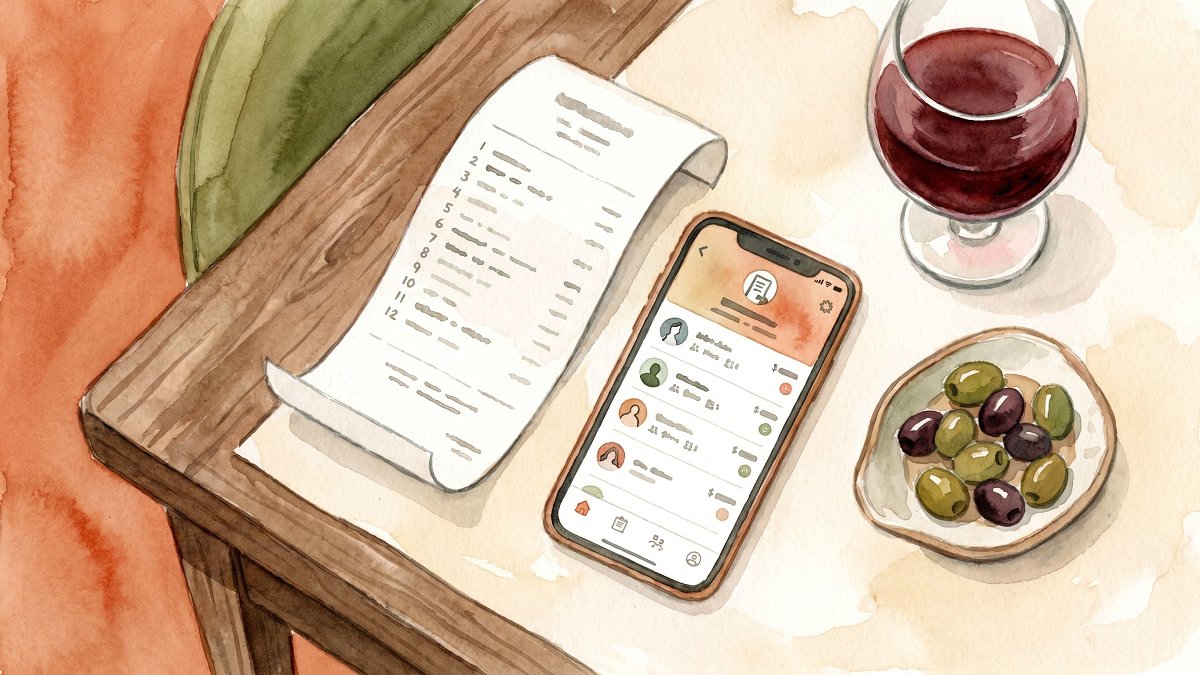
How to split bill by item, the eight sub-topics walked through
Each sub-topic below has its own short worked example, the named-app behavior that handles it, and a one-line script you can use at the table or in chat. Most groups need two or three of these on any given night out; have them ready.
Receipt line items
This is the foundation. To split bill by item you start by typing every line of the receipt into your app or a shared notes doc, with the price and a tag for who ordered it. A typical receipt has 8 to 14 lines: each dish, each drink, sometimes a side, sometimes a dessert. Splitwise on the iOS and Android app has a built-in scan flow that opens the camera, reads the receipt with optical character recognition, then asks you to tag each line. Tab and Plates by Splitwise work the same way. For a $120 bill across four people, the assignment work takes about 90 seconds. The script for the table: "I'll scan the receipt and tag the lines, who can confirm what they ordered?" For the deep dive, see how to split bill by item when receipt line items get tangled.
Shared versus individual
Every line on the receipt is either an individual item or a shared one. Mark it once and stick to it. An $18 burrata appetizer marked shared divides four ways at $4.50 per person; the same plate marked individual lands on whoever pointed at it. The mistake is mixing the two. If you assign the burrata to one person and they later tell you "oh, we all had some," go back into the app and switch it to shared, do not just trust your memory. Splid and Tricount both default new line items to individual; Plates and Splitwise default to shared if you check more than one diner. For more on the rule, split bill by item, the shared versus individual version covers the edge cases. Script: "Anything you want to flag as a share before I tap save?"
Tax and tip share
This is where most groups freeze. The clean rule is proportional: your share of tax and tip equals your subtotal divided by the total food and drink subtotal. If the food and drink subtotal is $200, tax is $18, and tip is $40, then a diner with a $50 subtotal pays 25% of the tax ($4.50) and 25% of the tip ($10), for a total of $64.50. American convention is to tip on the pre-tax subtotal because servers do not earn the tax line; in practice many people just tip on the bottom-line total because it is faster to calculate. Average full-service restaurant tips in the United States ran 19.2% in Q4 2025 according to a Toast restaurant trends report, with quick-service holding steady at 15.8%. Apps handle this automatically once items are assigned. Script: "I'm splitting tax and tip proportional to what each of us ate, fair?" Deeper walk-through at tax and tip share and split bill by item: how to keep it fair.
Appetizers and bottles
Group orders, the appetizers and the bottles, are the most common reason an itemized split goes sideways. The rule is to share only among the people who said yes. A $46 bottle of wine split among three drinkers is $15.33 each; the same bottle split across all five diners at the table would charge the two non-drinkers $9.20 each for something they did not have. To make this work in the moment, ask the question before the bottle hits the table: "Who is in on the bottle?" Then mark the line shared only among those names in your app. Splitwise supports custom shared groups per line; Tricount supports it via fractional shares. Average prix fixe wine pairings have crept to $48 to $65 per bottle in mid-tier US restaurants, so this single decision can be a $20 swing per person. See working out split bill by item for appetizers and bottles for the full playbook.
Bar tab only some drank
When a few people closed out the night with cocktails and the rest went home, do not bury the bar tab in the food bill. Pull the bar items out into a separate mini-bill assigned only to the drinkers. Food goes in the group pool, drinks land on the drinkers, and tax and tip on each portion follow that portion's headcount. Example: $300 food bill split five ways at $60 each, plus an $84 bar tab split among the three drinkers at $28 each. Total for a drinker: $88. Total for a non-drinker: $60. Bar tabs at full-service restaurants now often carry an automatic 18% to 22% service charge on parties of six or more, so verify before adding tip on top. Script: "Drinks are off the food bill, who is on the bar tab?" Topical fiche: what to do about bar tab only some drank.
Kids meals
The kid's order belongs to the parent paying for the kid, not to the adult pool. If four adults and one child are at the table, the $9 kids burger goes on the relevant parent's tab; the rest of the bill splits among the four adults using normal itemized rules. The common error is counting the child as a fifth diner, which makes every adult share artificially low and quietly gives the parent a discount. The same applies for shared appetizers: if the kid had a few fries off the shared plate, leave the appetizer in the four-adult shared pool and move on, the swing is under a dollar and not worth tracking. Script: "Kid's meal stays on us, the rest goes four ways." See the kids meals fix, with a script.
Two people shared one dish
This is the most common fractional case at any restaurant table. A $32 pasta that two friends actually shared is logged as $16 for each of them, and the tax and tip on the $32 line follow the standard proportional rule. If your app does not support fractional shares natively, the workaround is to enter the dish as two separate $16 expenses, one assigned to each person. The trap to avoid: agreeing to share verbally, then one person paying for the dish and forgetting to mark the other as a co-shared diner. Always state out loud who is on what share before the receipt arrives. Script: "Sam and Riley split the pasta, that's $16 each, agreed?" Detailed walk-through: two people shared one dish, sorted in five minutes.
Scanning receipts
Receipt OCR has gotten very good, but it is not perfect. Splitwise's receipt scanner is generally accurate on a clean printed receipt and stumbles on faded thermal paper, handwritten add-ons, or multi-column receipts from some bar point-of-sale systems. Always scroll through the scanned lines and verify before assigning. If any line is missing or has the wrong amount, fix it before you tag people. The five-second sanity check: does the sum of the scanned line items match the printed subtotal at the bottom of the paper? If yes, you are clear. If no, find the gap before you split bill by item. Script: "Scanning, give me one minute to check the lines." See a fair rule for scanning receipts.
When the simple rule for split bill by item breaks down, six fixes
The proportional rule above handles about 85% of restaurant bills. The other 15% need one of these six fixes. Use the matching numbered move when the moment calls for it.
- One person already paid the deposit. Subtract the deposit from the total before splitting. The depositor either gets that amount credited back, or the others pay them directly in cash or via a payment app such as Venmo or PayPal. NerdWallet notes that Venmo applies a 3% fee on credit card transfers, so settle with bank-funded transfers when possible.
- Service charge is automatic. A 20% auto-gratuity on parties of six or more does not need an additional tip line. If you add another 20% on top, you have just tipped 40%. Verify the receipt before adding a manual tip.
- Card minimums or split-check limits. Some restaurants cap the number of cards they will run for a single check, often at four. The workaround is one person pays the full bill on a single card, then the others settle up via app afterwards. This is exactly the use case Nudj exists for.
- Cash and card mixed. When some diners pay cash and others use a card, log the cash as a payment in your app so the running balances stay correct. The reconciliation is otherwise a quiet headache.
- Someone left early. The person who left covers their items plus a proportional cut of tax and tip on the items that were already on the bill before they left. They do not owe anything for the round of espressos that arrived after they were gone. Capture this in the moment, not later.
- Tip-eligible vs not. Wine bottles purchased to take home are not tipped on. Some upscale restaurants list these as separate line items. Pull them out of the tippable subtotal before applying the tip percentage.
These six are the most common breakdowns. The Reddit personal finance wiki collects community-tested scripts for several of these, and the threads under r/personalfinance on shared expenses are worth a scan when a truly weird case shows up at your table.
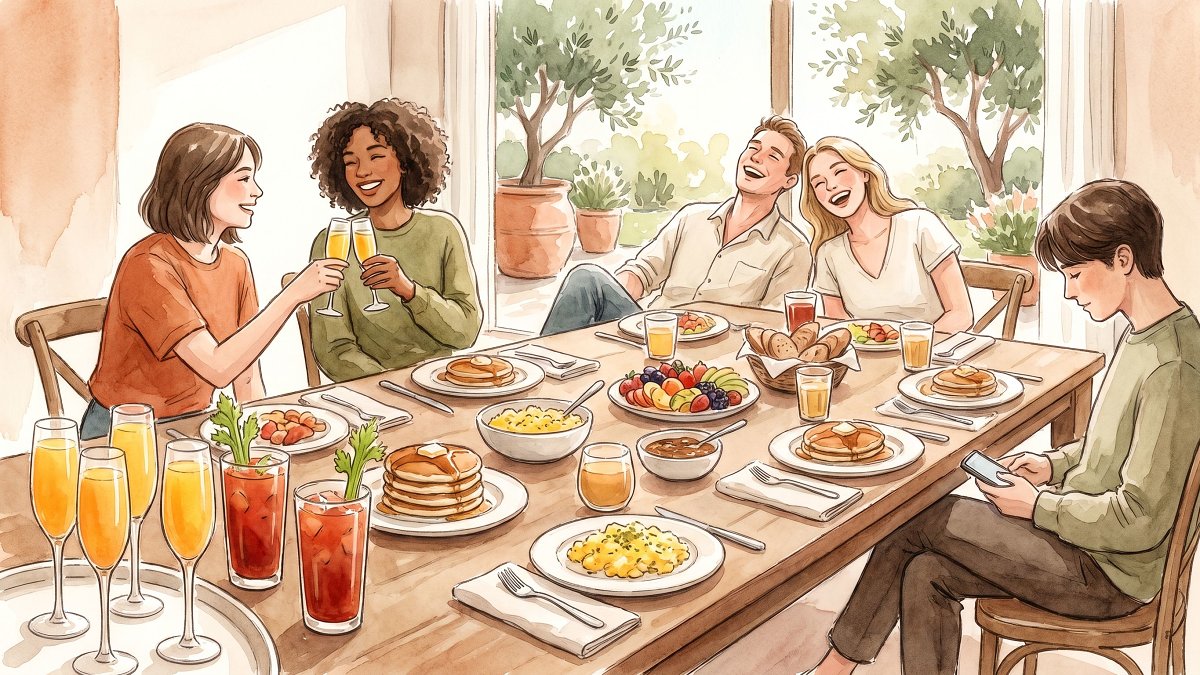
Three worked-out cases, a four way split bill, a six way split bill, and a recurring poker table
The theory above is best understood through real examples. These three cases walk a four way split bill, a six way split bill, and a recurring poker table from blank slate to settled balance.
A four way split bill at a casual dinner, with appetizers and one drinker
Four friends at a neighborhood spot. Total food and drink subtotal: $186. Tax at 9% adds $16.74. Tip at 20% on pre-tax adds $37.20. Grand total: $239.94. Breakdown: Alex ordered a $32 steak and a $14 cocktail. Sam ordered a $24 chicken plate. Riley ordered a $28 pasta. Casey ordered a $20 salad. The table shared a $24 burrata appetizer. The only drinker was Alex.
Individual subtotals: Alex $32 + $14 + $6 (one-quarter of the burrata) = $52. Sam $24 + $6 = $30. Riley $28 + $6 = $34. Casey $20 + $6 = $26. Cross-check the sum: $52 + $30 + $34 + $26 = $142, which lands short of the $186 food and drink subtotal printed on the receipt. The $44 gap is a dessert the table shared after the entrees. This is exactly why the rule is to verify line totals before assigning. Split the dessert four ways at $11 each and each pre-tip subtotal becomes Alex $63, Sam $41, Riley $45, Casey $37. Tax and tip together come to $53.94, distributed proportionally: Alex pays $81, Sam $53, Riley $58, Casey $48. The four shares sum back to $239.94, matching the grand total exactly.
A six way split bill on a long brunch with a bar tab
Six friends at a Sunday brunch. Food subtotal: $234 across mostly $30 to $45 plates. Bar tab: $96 across mimosas and bloody marys, four of the six drank. Tax at 9% on the full $330 subtotal: $29.70. Tip at 20% on pre-tax: $66.00. Grand total: $425.70.
The move for a six way split bill is to handle food and bar separately. Food at $234 splits six ways at $39 each plus each person's proportional share of tax and tip on the food portion. Bar at $96 splits four ways at $24 each plus the four drinkers' share of tax and tip on the bar portion. A drinker ends up paying around $81; a non-drinker ends up paying around $50. The two non-drinkers each save roughly $21 versus an equal split that would have charged everyone $70.95. Multiply that by a weekly brunch and you understand why this skill is worth the 90 seconds.
A recurring poker table that settles weekly
A Tuesday-night poker group of six runs ongoing tabs for the table snacks and beer. Across a month, the group spends $280 on pizza, $120 on beer (only four players drink), and $36 on snacks. Different players cover different runs each week. Without a ledger, no one can reconstruct who paid for what by week three.
The scalable move is to log every spend to a shared Table in a social ledger app such as Nudj, with each entry tagged to the relevant subset. Pizza splits six ways at $46.67 each. Beer splits four ways at $30 each. Snacks split six ways at $6 each. At the end of the month the app shows the net balance for each player, and the Pass mechanic simplifies the chain so one cross-transfer typically settles four or five outstanding debts. Total transactions to clear the month: usually two, sometimes three. This is the rare case where a four way split bill or six way split bill spans many separate purchases over many weeks; logging in the moment is the only way to keep it sane.
How Nudj Labs helps you split bill by item without arguments
If the math feels like more work than the dinner itself, that is exactly the gap Nudj was built to close. Nudj is a 100% free social ledger app for friends, with no premium tier and no ads ever. It is not a payments product, not a bank, and not a money services business; it logs who owes whom and helps you settle up through whatever payment method you already use.
Three mechanics handle most split bill by item moments:
Drop and Nudge. When a friend covers a dinner, you tap Drop to log what you owe them, line by line if you want. When it has been a week and nobody has settled, a polite Nudge sends a reminder that does not feel like a debt collector. The conversational tone is the whole point: groups already use the verbs "I owe you" and "you owe me," Nudj just gives those verbs a button.
Circles and Tables. A Circle is your everyday friend group: housemates, the brunch club, your travel group. A Table is a recurring context with its own ledger, the poker night, the fantasy league, the weekly dinner. Tables stop the natural drift where last month's debts get fuzzy. Every drop in a Table belongs to that Table; you can see the running balance for any player at any time.
Square Up and Pass. When two people are ready to settle, Square Up is a two-sided confirmation that both parties acknowledge the transfer. Pass simplifies tangled chains across a Circle: if Alex owes Sam $20, Sam owes Riley $20, and Riley owes Alex $20, Pass cancels the loop in one tap. For a four way split bill at the end of a trip, Pass typically reduces the settle from twelve transfers to two.
Nudj is web-only today, with iOS and Android apps in build. Sign up is one email, no card on file, no bank link. The web app is free at nudjlabs.com. The roommate-agreement template that pairs with this guide is in the sidebar for housemates who want to standardize the rules up front.
FAQ: split bill by item
What does it mean to split bill by item?
To split bill by item means each person at the table pays for what they actually ordered, plus a proportional share of tax and tip based on their subtotal, plus an even share of anything ordered for the group such as appetizers or wine. The opposite is an equal split, where the total is divided by headcount regardless of who ate what. Itemized splits are fairer when orders are very different, for example one person on a salad and another on a steak, lobster, and two cocktails.
How do you split tax and tip when you split bill by item?
Add each person's items to get their subtotal, then divide their subtotal by the food and drink subtotal to get their share percentage. Multiply tax and tip by that percentage. If your subtotal is $40 out of a $200 food and drink total, you pay 20% of the tax and 20% of the tip. Bill splitting apps such as Splitwise, Tab, and Plates do this automatically once items are assigned. In the United States the convention is to tip on the pre-tax amount.
What is the best app to split bill by item?
Most US groups use Splitwise for ongoing balances, Plates by Splitwise or Tab for one-off restaurant tabs, and Venmo or PayPal for the actual payment. The NYT Wirecutter best bill splitting apps roundup, updated in 2025, walks through the tradeoffs across these tools. Splitwise lets you scan a receipt, assign items, and email the math to the group. Splitwise has confirmed it does not plan to add unequal shares per item, so for percent-of-an-item splits use a separate expense entry.
How do you split bill equally versus split bill by item?
Split bill equally means total divided by headcount, fast and friendly but unfair when orders differ by more than about $10. Split bill by item means each person pays for what they ordered plus a proportional cut of tax and tip. The rule of thumb: if the largest order is more than 1.5 times the smallest order, switch to itemized. Same-bill swings of $25 or more usually pay back the two extra minutes it takes to itemize.
How do you split bill by item when two people shared one dish?
Add the dish as a 50 percent share for each of the two people. If a $32 pasta plate was shared by Sam and Riley, each of them adds $16 to their subtotal, and the tax and tip on that $32 follows the standard proportional rule. Most apps support fractional shares through a slider; if not, log the dish as two separate $16 expenses and assign one to each person. Always state out loud who is splitting before the receipt arrives so no one is surprised.
How do you split a bar tab when only some people drank?
Pull the alcohol line items off the food bill and treat them as a separate mini-bill assigned only to the drinkers. The food subtotal then splits among everyone, the bar subtotal splits among the drinkers, and tax and tip on each portion follow that portion's headcount. The script is one sentence: the food goes in the group pool and drinks land on whoever ordered them. A 22 percent service charge on a bar tab is now common, so check the bottom of the receipt before tipping again.
How do you split bill by item for a four way split bill with one kid's meal?
Treat the kid's meal as an individual item charged to the parent who is paying for the kid, not as a quarter share of the table. The remaining items either go itemized to the three adult diners and the second parent, or get pooled and divided three ways depending on what was shared. The rule that keeps a four way split bill from imploding: the kid's meal never enters the adult pool, even if it was the cheapest thing on the table.
How do you split bill by item for a six way split bill on a group trip?
For a six way split bill across multiple restaurants on the same trip, do not itemize every meal in the moment. Log each receipt to one payer and reconcile at the end using a settle-up app such as Nudj or Splitwise. The app calculates who owes whom in the fewest possible transfers. For a single shared meal, the itemized approach still wins because group means and tastes diverge sharply at six people.
Conclusion
The receipt at the bottom of the table is not actually about money. It is about whether your friends feel taken care of. To split bill by item is the small operational discipline that keeps generous people generous and quiet people from feeling stuck with someone else's lobster. Walk in with the rule in your head, do the proportional tax and tip move, pull the bar tab out for the drinkers, keep the kid's meal off the adult pool, and you will be the person at the table everyone wants to invite back. Pick one app, get the group on it, and the math becomes a 90-second move at the end of dinner. That is what evergreen good manners look like when there are six plates on the table and one paper receipt.
À lire également :
- How to Split bill by item When Receipt line items
- Split bill by item, the shared versus individual version
- Tax and tip share and split bill by item: how to keep it fair
- Working out split bill by item for appetizers and bottles
- What to do about bar tab only some drank
- The kids meals fix, with a script
- Two people shared one dish, sorted in five minutes
- A fair rule for scanning receipts
Sources :
- 2026 Restaurant Tipping Guide : Toast, 2026.
- Tipping culture survey: what Americans say about tipping : Bankrate, 2025.
- From friends to foes: financial incompatibility study : Bread Financial, 2024.
- Itemised bill with unequal sharing, feature request : Splitwise feedback, 2024.
- Split the bill easily with these credit cards and apps : NerdWallet, 2025.
- The best bill splitting apps : NYT Wirecutter, 2025.
- Personal finance subreddit wiki : Reddit, 2025.
- Splitwise on the App Store : Apple App Store, 2025.