You ordered the salad. Your friend got the steak, the second cocktail, and the dessert that costs more than your entrée. The check arrives, the math starts, and someone is about to feel cheated. The split tip restaurant problem is less about money than about whether you still want to share a table next month.
This hub walks through eight ways to split tip restaurant bills cleanly, without an argument and without a calculator-app meltdown. Each section gives you the rule, a worked example in real dollars, the typical mistake, and a script you can paste into the group chat before the check lands. The numbers reflect 2026 US norms. According to Toast's POS data on average tip percentages, the average tip at full-service US restaurants was 19.2% in Q4 2025, but the right number for tonight depends on the situation, not the average.
Key takeaways
- The average US full-service tip was 19.2% in Q4 2025 (Toast, 2026). Tips and service charges are taxed differently by the IRS, so reading the bill matters.
- Proportional tip is the fairest default when orders are uneven; flat tip is faster when the bill is roughly even.
- Tax follows the item, never the diner. Most split tip restaurant arguments start when someone tips on the post-tax total.
- 81% of US adults who eat at sit-down restaurants say they always tip (Pew Research Center, 2023, n=11,945), but 65% say they are 'tired of tipping' (Bankrate / YouGov, 2024). Naming the math out loud helps.
- Auto-gratuity on large parties is a service charge, not a tip, and is taxed as wages, per IRS guidance.
What 'split tip restaurant' actually covers
Splitting a restaurant bill is one math problem until you try to do it for eight friends with different orders, a shared appetiser, sales tax, an included service charge from the bar, and a friend who tips like it is 1985. Then it is eight problems with eight answers.
The split tip restaurant question really covers eight cases. Each one needs a different rule:
- Proportional tip. Everyone tips based on what they ordered.
- Flat tip. Everyone contributes the same dollar amount.
- Tax on shared items. Who pays for the appetiser's tax?
- Service charge included. Do you tip on top, and how much?
- Tip only on pre-tax. Tip on subtotal, not on the post-tax total.
- Rounding the tip. Smoothing the math so nobody owes 73 cents.
- Tipping by country. Local norms when you travel.
- Auto-grat large groups. Reading the bill before you tip again.
The next eight sections walk through each case with a worked example, the script you can use at the table, and the mistake that turns dinner into a 20-minute argument. NerdWallet's bill-splitting guidance, the Splitwise help center, and the Reddit r/personalfinance community all agree on the basic framing of the split tip restaurant question. They disagree on the dollar examples and the scripts. This page closes that gap.
Here is the cheat sheet, all eight cases at a glance.
| Sub-topic | Rule | Dollar example | Typical mistake |
|---|---|---|---|
| Proportional tip | Tip on each person's pre-tax subtotal | $20 entrée pays $4 of a $20 tip; $60 entrée pays $12 | Splitting tip equally when orders differ wildly |
| Flat tip | Same dollar amount each | 4 people, $100 subtotal, 20% tip = $5 each | Skipping tax in the per-person total |
| Tax on shared items | Tax follows the item | $4 chips + 8% tax = $4.32; split 4 ways = $1.08 each | Charging shared-item tax evenly to everyone |
| Service charge included | If 18% is on the bill, no extra tip needed | $100 + $18 service charge = $118 | Adding 20% tip on top of the included charge |
| Tip only on pre-tax | Tip on subtotal, not post-tax total | 20% of $100 = $20, not 20% of $108.75 | Letting the POS tablet default to post-tax tip |
| Rounding the tip | Round to a clean number | $18.40 tip rounds to $20 | Fighting over 60 cents |
| Tipping by country | Local norm overrides US habit | Tokyo: ¥0; London: 12.5% often already in | Tipping where it is rude or already included |
| Auto-grat large groups | Bill already has gratuity | Party of 8: $144 auto-grat on $800 | Tipping 20% on top, paying ~38% total |
Sources synthesized from Toast (2026), Pew Research Center (2023), Lightspeed automatic gratuity guide (2024), and Wikipedia tipping customs by country (2026).
Proportional tip, the fairest default
Proportional tip is the rule when orders are uneven. Everyone tips on what they ordered, before tax. Two appetisers and a salad pay less than the steak entrée and two cocktails, in tip as well as in food. The split tip restaurant default in most US apps is proportional, and for good reason: it is the only rule that makes the math match the appetite.
The math is simple even when it sounds bureaucratic. Add up your own items, take 20% of that, add it to your share. The total of every person's tip should equal 20% of the pre-tax subtotal.
Worked example. Four people, pre-tax subtotal of $200. Alex ordered $80 worth of food, Sam ordered $60, Jess ordered $40, Pat ordered $20. The 20% tip on the subtotal is $40. Alex pays $16 of the tip, Sam pays $12, Jess pays $8, Pat pays $4. Everyone's tip is exactly 20% of what they ordered.
Script you can paste before the check arrives.
'Let's do proportional tip tonight, so the orders match the tip. Add 20% to your own subtotal and Venmo me your number. Easier than the math at the table.'
This is the rule that bill-splitting apps default to. Splitwise's shares feature distributes tip and tax across uneven shares automatically when you enter the post-tax total and the itemized subtotals. NerdWallet recommends the same approach: tax and tip calculated for everyone in the app and divided proportionally. The reason it is the default is statistical. According to the Pew Research Center's 2023 tipping survey of 11,945 US adults, 81% always tip at sit-down restaurants, but only 35% tip 20% or more (Bankrate / YouGov 2024, n=2,445). Pegging tip to what each person ate means nobody is forced to over-tip on someone else's wine list.
If your group cannot face the per-person math at the table, the topical guide on how to split a proportional tip across a restaurant table walks through three variations: pre-tax subtotal, post-tax total, and how to handle a single late arrival.
Typical mistake. Splitting the tip evenly when orders differ wildly. The person with the salad subsidises the person with the steak, and small grudges build up over six months of group dinners. If you want to split tip restaurant fairly, proportional is the move.
Flat tip when the bill is roughly even
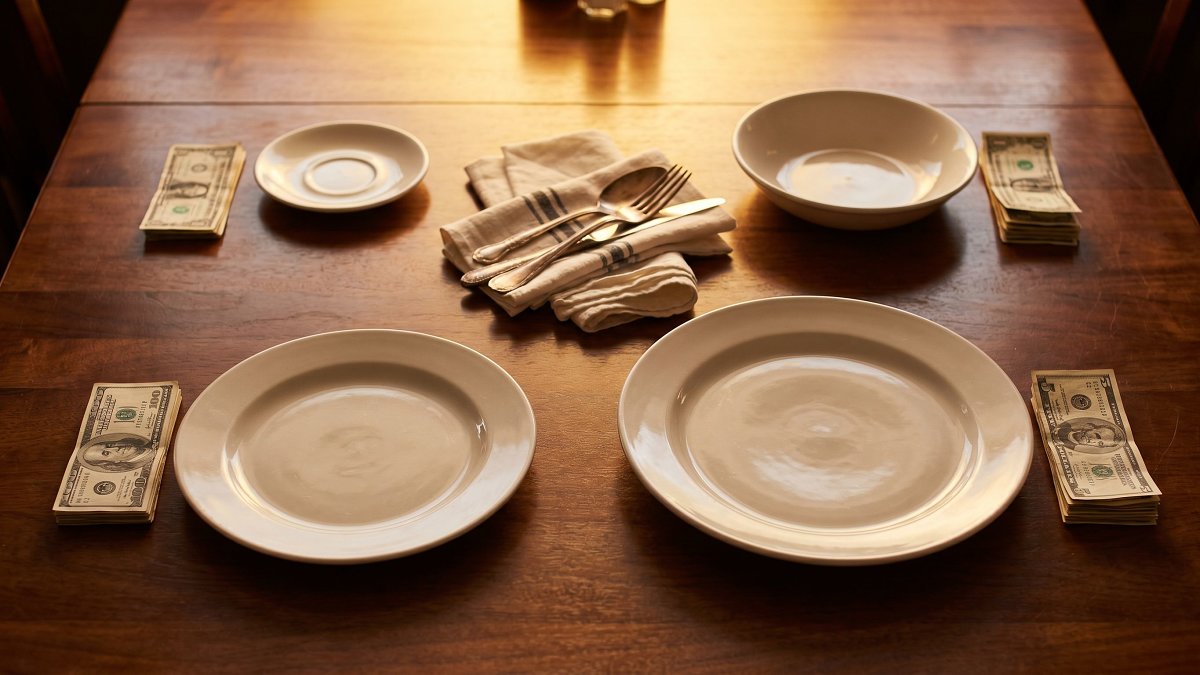
Flat tip is the rule when nobody wants to do per-person math and the orders are within $10 to $15 of each other. Everyone puts in the same dollar amount, computed off the full subtotal divided by the number of people. It is the fastest split tip restaurant rule when the orders are close.
Worked example. Four friends, pre-tax subtotal $100. Tip target 20%, total tip $20. Each person contributes $5 to tip, plus their share of the food and tax. If sales tax is 8% ($8), the post-tax post-tip bill totals $128. Each person pays $32.
Script.
'Flat tip tonight. Total comes to $128, that is $32 each. Tax and tip already in. Venmo me.'
Flat tip is the right call when:
- Orders are close. Everyone got a $20 to $25 entrée and one drink.
- You are in a hurry. The math takes 10 seconds for any group size.
- You trust the group. Nobody is keeping score across the year.
It is the wrong call when one person ordered nothing but tap water and chips, or when one person ordered the bottle of wine that doubled the bill. In those cases, the split tip restaurant move is to switch to proportional and absorb the 30 seconds of extra math.
The focal piece on how to use a flat tip when the bill is uneven covers the cleanup script when one person realises mid-conversation that flat tip is unfair to them, and the no-drama way to switch to proportional without making the original drinker feel called out.
Typical mistake. Forgetting tax in the per-person total. A flat tip on a $100 subtotal is $5 each, but the per-person bill is $32 ($25 food + $2 tax + $5 tip), not $25 ($20 food + $5 tip). When the credit card machine spits out a number $7 higher than expected, the math starts over and tempers go up.
Tax on shared items, who pays for the appetiser?
Tax follows the item, never the diner. Same rule as for any sales-tax calculation: the appetiser was taxed, so the people who ate it pay the appetiser's tax in the same shares they pay the appetiser. This is one of the most common split tip restaurant edge cases, because half the table will not realise tax was applied to the share at all.
Worked example. Four friends share a $20 plate of nachos. Sales tax in your state is 8%, so the nachos cost $21.60 with tax. Each share is $5.40 ($20 / 4 + $1.60 / 4). The per-person sales tax on the shared item is $0.40, the per-person food is $5.00. Anyone who skipped the nachos pays $0 for them, including the tax on them.
Script.
'Nachos were $21.60 with tax, four of us shared. That is $5.40 each from Pat, Sam, Jess and me. Alex skipped them, so Alex owes nothing for the nachos.'
Bill-splitting apps treat tax in two different ways. Splitwise calculates shares on the pre-tax, pre-tip subtotal unless you manually adjust the post-tax total. The itemized bill feature on the Splitwise web app, currently web-only as of late 2025, can prorate tax across items if you enter them line by line. Venmo Groups does not handle line-item tax allocation, so users prorate tax manually before entering the per-person totals.
For the simplest case, prorate the tax on shared items as a flat additive to the item, not as a separate column. An 8% sales tax on a $20 appetiser is $1.60. Split that $1.60 the same way you split the $20.
The dedicated piece on how to fairly allocate tax on shared items covers the messier case: when one shared item is taxed and another is not (some states do not tax bottled water, for example), or when one diner had a tax-exempt order because of a coupon.
Typical mistake. Charging shared-item tax evenly to everyone at the table. If Alex did not eat the nachos, Alex should not pay tax on the nachos. The split tip restaurant rule is simple: tax follows the item, never the diner.
Service charge included, do you tip on top?
A service charge included on the bill is a different animal from a tip. The IRS classifies an automatic service charge as wages, not tip income. The restaurant collects the service charge as revenue and pays it to staff as part of payroll. The customer's leverage is gone the moment the line appears on the bill, and the split tip restaurant calculation changes accordingly.
Worked example. Bill arrives with a 'Service Charge 18%' line item already added. Pre-tax subtotal $100. Service charge $18. Sales tax 8% on $100 = $8. Bill total $126. Each of four people pays $31.50. No additional tip is required.
Script for service charge included.
'There is already an 18% service charge on the bill. We do not need to add tip on top. Total is $126, that is $31.50 each.'
Whether to tip on top is a judgement call. The rule of thumb from US restaurant industry guidance: when a service charge is itemized at 18% or more, no additional tip is necessary. When the service charge is less than 18% (such as a 10% kitchen contribution), round up to bring the total to 18 to 20% of the pre-tax subtotal. Service charges are always subject to sales tax (per New Mexico Restaurant Association guidance), unlike tips, so the post-tax total is slightly higher than a comparable tip would produce.
In some markets, especially restaurants in California after the 2024 update to state law on hidden fees (Senate Bill 478, effective July 2024), all mandatory service charges must be disclosed up front. The bill will show one total with the gratuity already baked in.
The dedicated guide to handle a service charge included on the check covers what to do when the service charge is less than 15%, when staff say the charge is for 'kitchen', and when the language on the receipt is unclear.
Typical mistake. Adding a 20% tip on top of an 18% included service charge. Now the staff get 38%, the customer feels confused, and the math at the table starts over.
Tipping only on the pre-tax subtotal
Tip on the subtotal before tax, not on the total after tax. The principle is that sales tax is a government collection, not a service rendered. Bankrate's senior industry analyst recommends 20% at sit-down US restaurants, calculated on the pre-tax subtotal. This is the split tip restaurant convention that point-of-sale tablets in 2026 routinely violate by suggesting post-tax tip percentages.
Worked example. Pre-tax subtotal $100. Sales tax 8.75% (New York City) = $8.75. Post-tax total $108.75. The 20% tip on the subtotal is $20. The 20% tip on the post-tax total would be $21.75. Difference: $1.75 to the staff, $1.75 less from the table. Across a four-person table, that is the price of a single cocktail per group dinner.
Script.
'Tip is 20% of the subtotal, $20. Do not tip on the tax line, that is the city's money.'
The split tip restaurant convention in the US is to tip on the pre-tax subtotal. Restaurants in many European cities print 'service compris' (service included) on the menu instead, eliminating the question entirely. In the US, the standard is pre-tax tip, even when card terminals default to a post-tax calculation. Look at the bill before you accept the suggested tip percentages.
The focal piece on how to tip only on the pre-tax subtotal without sounding cheap covers the etiquette of pointing out the math at the table without sounding stingy, and the cleanest way to override the post-tax suggestion on a card machine.
Typical mistake. Calculating tip on the post-tax total. Over a year of group dinners, the difference compounds into a real number.
Rounding the tip without starting an argument
Round the tip up to a clean number, every time. Nobody at a restaurant wants to do math past two decimal places, and nobody at the table wants to argue over 73 cents. Every split tip restaurant guide on the open web (Reddit's r/personalfinance threads, NerdWallet, SoFi) lands on the same advice: round up.
Worked example. Pre-tax subtotal $92.40. Twenty percent of $92.40 is $18.48. Round up to $20. The math is cleaner, the server is happier, and the per-person split lands in whole dollars.
A small additional rule: when the rounded number lands halfway between $18 and $20, round up. The math benefit is small. The social benefit is large. A $20 tip on $92.40 is 21.6%, very close to the 19.2% US average reported by Toast in Q4 2025 but on the generous side.
Script.
'Tip rounds to $20. Bill total $120.40, that is $30.10 each, let us just say $30 even.'
The split tip restaurant rounding convention is: round the tip up, round the per-person share to the nearest dollar (or the nearest 50 cents if the group is large). Anyone who insists on exact change at a casual dinner is asking to be left off the next group chat.
The dedicated piece on how to round the tip to a clean number covers the script for the rounding-resistant friend, and a fast mental-math shortcut for tipping in restaurants without a calculator app.
Typical mistake. Fighting over 60 cents. The cost of one minute of group conversation is more than the savings. Round up, move on, eat dessert.
Tipping by country, the move when you travel
Local norm overrides US habit. The 20% standard you learned in New York is wrong in Tokyo, optional in London, irrelevant in Beijing, and almost insulting in Reykjavik. The split tip restaurant rule abroad is the local rule, full stop.
Worked examples by country.
| Country | Restaurant norm | What to leave |
|---|---|---|
| United States | 15 to 20% pre-tax | $20 on a $100 subtotal |
| United Kingdom | 12.5% often added as service charge | If not added, round up or leave 10% |
| France | Service included by law (15%) | Round up to nearest euro; up to 5% for exceptional |
| Germany | 5 to 10% via round-up | 'Stimmt so' or 'keep the change' |
| Italy | Uncommon, only for exceptional service | A few euros if you want |
| Japan | Not practiced, can be considered rude | Nothing; service is in the price |
| China | Traditionally none in local restaurants | Nothing standard |
| Mexico | 10 to 15% in mid to high-end restaurants | 10 to 15% of bill |
| Australia | Not expected | Optional round-up |
| Spain | Not mandatory; depends on quality | A few euros for good service |
Source: Wikipedia list of tipping customs by country (2026 edition), cross-checked against country-specific etiquette guides.
The split tip restaurant calculation gets easier overseas in two ways. First, in many European, Asian, and Latin American countries, service is in the price, so there is no tip line to math out. Second, in countries where rounding up is the norm (Germany, France for small bills), the per-person share is trivially equal: divide the total by the number of people, add a couple of euros, done.
Script for a four-person dinner in Tokyo.
'No tip in Japan. Bill is ¥12,000. That is ¥3,000 each. Settle later when we are back in the same currency.'
The focal piece on how to adjust tipping by country when you travel covers the script for the friend who insists on tipping American at a sushi counter in Osaka, and a quick mental-map of where service is in the price versus where you still need to leave something.
Typical mistake. Tipping the way you tip at home. Either you offend the server in Japan, you double-tip in Paris where the 15% is already baked in (and visible as 'service compris'), or you stiff the server in Manhattan because you defaulted to the 5% European habit.

Auto-gratuity on large groups, how to read the bill
Auto-gratuity is a service charge, not a tip, added by the restaurant to bills for parties usually six or more. The IRS confirms in its long-standing guidance on automatic gratuity, surveyed clearly in the Lightspeed automatic gratuity laws guide, that auto-grat fees are wages, not tips, and are subject to payroll tax (Social Security, Medicare, federal unemployment). The line item is mandatory; the customer cannot reduce it. The split tip restaurant rule for auto-grat is: read the bill first.
Worked example. Party of 8 at a sit-down restaurant. Pre-tax subtotal $800. The bill has a line 'Service Charge for parties of 6 or more: 18%' which adds $144. Sales tax 8% on $800 = $64. Bill total $1,008. Each person pays $126.
There is no additional tip line to fill in. The 18% has already done the work. Some restaurants leave an optional 'additional gratuity' line, which is genuinely optional.
Script for an auto-grat large group dinner.
'There is an 18% service charge already on for our party of 8. No additional tip needed. Total is $1,008, that is $126 each.'
A few details to read carefully on the receipt:
- Threshold. Most US restaurants apply auto-grat at 6 or 8 people, though some apply it at 5. The fine print on the menu usually states the threshold.
- Disclosure. New York requires auto-grat to be 'clearly and conspicuously' disclosed before ordering, per state Department of Labor guidance.
- Card vs. cash. The auto-grat appears as part of the printed total. If you pay in cash, you owe the listed total, not the listed subtotal plus 20%.
- California after 2024. Senate Bill 478 requires all mandatory fees to be included in the displayed menu price, so an auto-grat line on a California restaurant bill is rarer than it used to be.
- Federal changes. The One Big Beautiful Bill signed in July 2025 lets employees in traditionally tipped roles deduct up to $25,000 in qualified tip income through 2028, but auto-grat (a service charge) is excluded from this break.
The split tip restaurant question on auto-grat is straightforward: do not double-tip. If service was outstanding and you want to add more, write an explicit 'additional gratuity' amount on the line provided, not in the auto-grat field. The focal piece on how to handle auto-gratuity on large parties covers the script for politely splitting the auto-grat receipt across 12 people, and the workaround when one diner left early.
Typical mistake. Tipping 20% on top of an 18% auto-grat. Now staff get 38%, the table pays $189 each instead of $126, and someone is going to feel cheated when they re-read the bill three days later.
When the simple rule breaks down: real cases and copy-paste scripts
The eight rules above cover 95% of split tip restaurant scenarios. The remaining 5% are the cases everyone remembers as 'that night dinner went sideways'. Here are three real-world variations, anonymised, drawn from actual group dinners.
Case 1. The latecomer who orders nothing but a glass of wine. Eight people at brunch in San Francisco, 11am to 2pm. Seven brunches at $35 each plus drinks, one latecomer who arrived at 1:15 and only had a $14 glass of wine. The bill comes to $360. The latecomer pays for the $14 wine plus $1.12 sales tax plus $2.80 tip, total $17.92. The rest of the table proportionally splits the remaining $342.08.
Case 2. The bottle of wine that doubled the bill. Four friends, two of whom ordered a $180 bottle of Châteauneuf-du-Pape, two of whom ordered $9 beers each. Pre-tax subtotal $300. The wine drinkers pay the wine ($180 + tax + 20% tip = $214 between them). The beer drinkers pay only their share of food and beers. Without a separate wine ledger, the split tip restaurant math would force the beer drinkers to subsidise the wine.
Case 3. The 20-person rehearsal dinner. Twenty people, pre-tax subtotal $1,800. Auto-gratuity 20% ($360). Sales tax 8% ($144). Bill total $2,304. Per-person share $115.20. Three diners are non-drinkers, four ordered the prix fixe at $90, the rest ordered à la carte. The host pre-decided everyone would pay an even $120 to keep the math simple, with a $15 credit each for the non-drinkers. Final per-person net: $105 for non-drinkers, $120 for drinkers.
Five-step setup for any split tip restaurant scenario.
- Pick the rule before the menus arrive. Flat or proportional, decided in 30 seconds.
- Name the tip percentage out loud. 'We are doing 20% on the subtotal,' said before anyone orders.
- Note who has dietary constraints. Non-drinkers, allergies, picky eaters often eat less and should not subsidise.
- Decide on tax handling. Tax follows the item; shared items prorate; nobody pays for what they did not eat.
- Agree on settlement. Same-night Venmo, Zelle, Cash App, or a Nudj ledger. Up to the group.
The decision framework above takes 60 seconds at the start of dinner and prevents 60 minutes of awkwardness at the end. A bill-splitting tool that supports unequal shares (Splitwise's web itemized bill feature, NerdWallet's recommendations for app workflows, or Nudj's Drop & Nudge mechanic) carries the math so nobody has to do it at the table. The NYT Wirecutter bill-splitting app roundup and Reddit's r/personalfinance threads confirm the same lesson: name the rule before you order, not after the check arrives.
How Nudj makes split tip restaurant scenarios painless
Nudj is a free social ledger app for friends, designed for exactly the split tip restaurant scenarios above. Nudj is not a bank, not a money services business, not a payments processor. It does not move money, it does not connect to your bank account, and it never stores card numbers. What Nudj does is track who owes whom and make the 'settle up' conversation easier.
Drop and Nudge. When the check arrives, you log a Drop: '$31.50, dinner at Rosa's, owed by Alex, Sam, and Jess to me.' Each friend gets a polite Nudge to pay through whatever channel they prefer, with no demand language and no escalation tone. The repayment itself can happen on Venmo, Cash App, Zelle, Wise, or in cash. Nudj just keeps the ledger.
Circles and Tables. For recurring split tip restaurant groups, a Circle (general friend group) or a Table (a specific recurring context such as a monthly dinner club or a poker night) keeps the running balance month after month. The eight scenarios in this hub collapse into a single running ledger instead of eight separate Venmo threads, so nobody has to remember three weeks later who paid for which round of appetisers.
Square Up and Pass. When the running tab gets tangled (Alex owes Sam, Sam owes Jess, Jess owes Alex), Pass simplifies the chains so the final settlements involve the fewest possible payments. Square Up confirms each settlement with both sides, so nobody is left wondering whether last month's brunch was paid or not. The math at the table goes away because the ledger never forgets, even when the receipt does.
The free, no-ads promise. Nudj is 100% free, with no premium tier and no ads. The competing apps NerdWallet, NYT Wirecutter, and the broader bill-splitting space list, including Splitwise and Tricount, have either added ads, paid tiers, or both. Nudj's web app is live today. Native iOS and Android apps are next.
Nudj will not solve your group's tipping philosophy. It will, however, retire the calendar entry 'remind Sam about brunch from three weeks ago.' Try the Nudj web app the next time the split tip restaurant math threatens to ruin dessert.
FAQ: split tip restaurant
What does 'split tip restaurant' mean exactly?
The split tip restaurant question is shorthand for 'how do we split the tip and the tax when several people at a restaurant share one bill?'. There are eight common variations covered in this hub, ranging from proportional tip on uneven orders to handling an auto-gratuity already added to the bill. The rule changes with the situation. In most US sit-down dinners, the right rule is tip 20% on the pre-tax subtotal and prorate the result across orders by what each person actually ate.
Do you tip on tax when you split a restaurant bill?
No. The US convention is to tip on the pre-tax subtotal, not the post-tax total. Bankrate's senior industry analyst recommends 20% on the subtotal, and Toast's 2026 data shows the US average tip stabilised at 19.2% in Q4 2025, calculated on the subtotal. Tipping on the post-tax total inflates the tip by roughly 8 to 10%, depending on the state's sales tax rate. The IRS does not consider sales tax taxable income for the server, so tipping on tax just shifts money from the table to the staff with no rule behind it.
Is it rude to ask to split tip restaurant bills by item?
Not at all. Most US restaurants will split a check by item if you ask before the meal starts, and many point-of-sale systems do it in 30 seconds. The Reddit r/personalfinance community consistently advises that asking up front is normal; asking at the end of a 90-minute dinner is rude only to the server, not to the group. Bring it up before you order, and most of the friction disappears.
How do you split a four way split bill when one person ordered only water?
Proportional tip. The water-only diner pays for their water (often $0 in the US) plus their share of any shared appetiser plus the tip on those items. If they shared no appetisers, they pay close to $0. This is the cleanest case for proportional tip and the worst case for flat tip, where the water-only diner would pay 25% of a steak dinner they did not eat.
What is the cleanest way to split bill equally with tip and tax?
Flat tip on the post-tax total, rounded up to a clean number. Four people, $128 total post-tax post-tip, that is $32 each. The same rule scales to a six way split bill: divide the post-tax post-tip total by six, round up to a clean dollar amount, and everyone pays the same. This works when orders are within 10 to 15% of each other. When orders diverge sharply, switch to proportional tip.
Should you tip extra if the restaurant already added a service charge?
No, in most cases. If the bill shows 'Service Charge 18%' or 'Auto-Gratuity 18%', the gratuity is already part of the total. The IRS classifies service charges as wages, not tips, so they are taxed differently than voluntary tips. Customers in California (after Senate Bill 478, July 2024) and a growing list of states are now legally protected from being asked to tip again on top of a disclosed service charge. Read the receipt before adding anything.
Conclusion
Eight cases, one underlying principle: name the rule before the menus arrive, do the math once, settle the same night. The split tip restaurant problem is solved at the start of the dinner, not at the end. Pick proportional or flat tip, decide who pays for the shared appetiser, read the service charge line, and let a free social ledger like Nudj carry the running tab so the math never has to happen at the table again.
If you still want to split tip restaurant bills the old way with mental math, a $20 tip on a $100 subtotal is the same in 2026 as it was in 2006. The conversation is what has changed. Get the rule on the table early, settle the same night, and stay friends.
À lire également:
- Split a proportional tip across a restaurant table
- Use a flat tip when the bill is uneven
- Fairly allocate tax on shared items
- Handle a service charge included on the check
- Tip only on the pre-tax subtotal without sounding cheap
- Round the tip to a clean number
- Adjust tipping by country when you travel
- Handle auto-gratuity on large parties
Sources:
- Toast, 'Restaurant Tipping: What is the Average Tip Percentage?': 2026 industry data on average US tipping at full-service restaurants, drawn from 1.2 billion restaurant transactions.
- Pew Research Center, 'Tipping Culture in America': 11,945-adult survey on US tipping habits, November 2023.
- Bankrate / YouGov tipping culture survey: 2,445-adult US survey on attitudes toward tipping, June 2024.
- Bankrate, 'The Latest Rules of Tipping': guidance on US restaurant tip percentages.
- Lightspeed, 'What You Need to Know About Automatic Gratuity Laws': IRS treatment of service charges, state-by-state disclosure rules.
- NerdWallet, 'Split the Bill With These Credit Cards and Apps': bill-splitting app comparison and credit-card rewards guidance.
- Wikipedia, 'List of tipping customs by country': country-by-country tipping norms.
- Splitwise help center: tax and tip configuration: how Splitwise handles tax and tip across uneven shares.
- New Mexico Restaurant Association: service charge vs tip: tax treatment of service charges.
- Paychex, 'Tax on Gratuity vs. Service Charge': payroll-tax treatment of tips vs service charges.
- NYT Wirecutter, 'Best Bill-Splitting Apps': editorial roundup of bill-splitting apps.
- Reddit r/personalfinance wiki: community guidance on splitting bills.
- CNBC, 'Trump No Tax on Tips and the future of service fees': 2025 federal tax changes on tips and auto-gratuity, including the $25,000 deduction cap through 2028.
- SoFi, 'How to Split the Bill Politely': etiquette guidance for splitting restaurant bills among friends.